poemas de sal y tierra (poems of salt and soil), a group exhibition curated by homework and FORGOTTEN LANDS
Exhibition Duration:
April 12th – May 31st, 2025
Gallery Location:
homework, 7338 NW Miami Ct, Miami, FL 33150
Anticipation dances in the atmosphere as a few cultural practitioners and I begin to head to the opening reception of the poemas de sal y tierra (poems of salt and soil) group exhibition curated by FORGOTTEN LANDS and homework. It was shy of an hour and a half before the reception was to begin, and I was buzzing with anticipation and joy to support this divine collaboration, the many artists in the show whose work I have become quite fond of, and an exhibition that already reads as an intersectional embrace.
I was not the only one who made it a point to arrive earlier than intended at the opening reception. More people flowed into the space, adorning prideful and supportive smiles. This show’s title and exhibition text hold multiple layers of cultural resonance, reflecting the artworks on view.
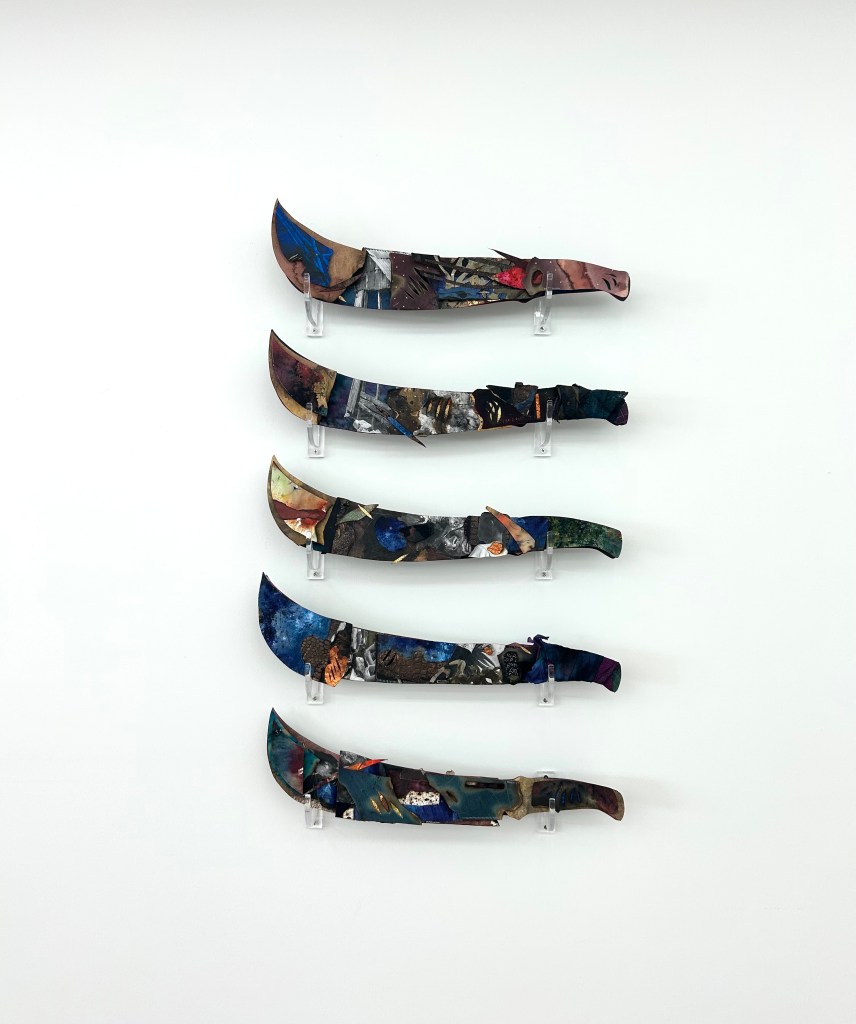
A body of work that immediately caught my attention was five machete-shaped sculptures embellished with photographs, coffee, paper that resembled fabric, and acrylic. The shape of the object and the way it was displayed swiftly and firmly evoked memories. Images of community members cutting sugarcane in the sticky summer heat in Port Antonio, Jamaica, flood my mind. Each sculpture and the mixed media that adorn them hold a heavy weight of calling to collective memories and materials, which echoes throughout this exhibition.

A mere few steps away, behind a curtain, is an intimate installation composed of a 35-minute sound arrangement played through 4 speakers. Each pair of speakers speaks to different neighborhoods in Havana, Cuba: Habana Vieja, Centro Habana, Vedado, and Guanabacoa. This soundscape is accompanied by symbolic materials and personal memorabilia representing each recorded neighborhood.
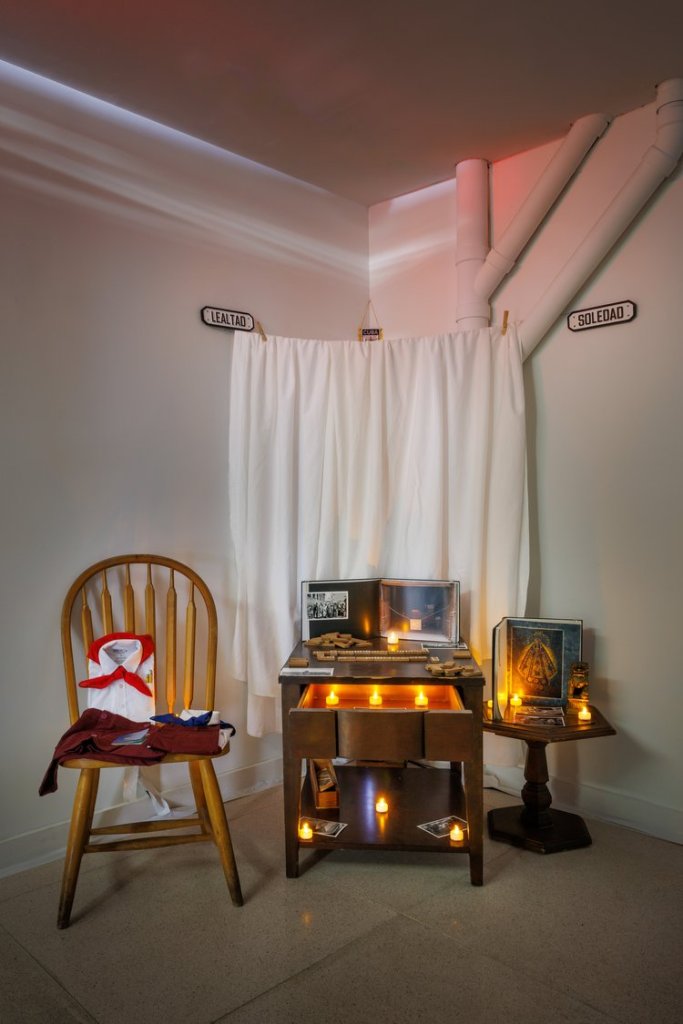
The moment I stepped inside this installation, I felt warmly blanketed by the different voices seeping from each speaker. It felt like we were given a round-trip ticket to each neighborhood through the lens of Casamayor’s childhood memories in this soundscape, which included familial archival photographs, school uniforms, and an altar. The conversations that flowed through the room were nostalgic and somber. Casamayor’s installation has a powerful way of holding space for one to tenderly hold their childhood memories that still percolate in the now.
The exhibition is an engaging curatorial collaboration between the homework gallery, founded by Aurelio Aguiló and Mayra Mejia, and the FORGOTTEN LANDS team, comprising founders Cory Torres Bishop and Don Brodie, along with their Partnerships and Programs director, Amanda Bradley, a Miami-based artist and curator.
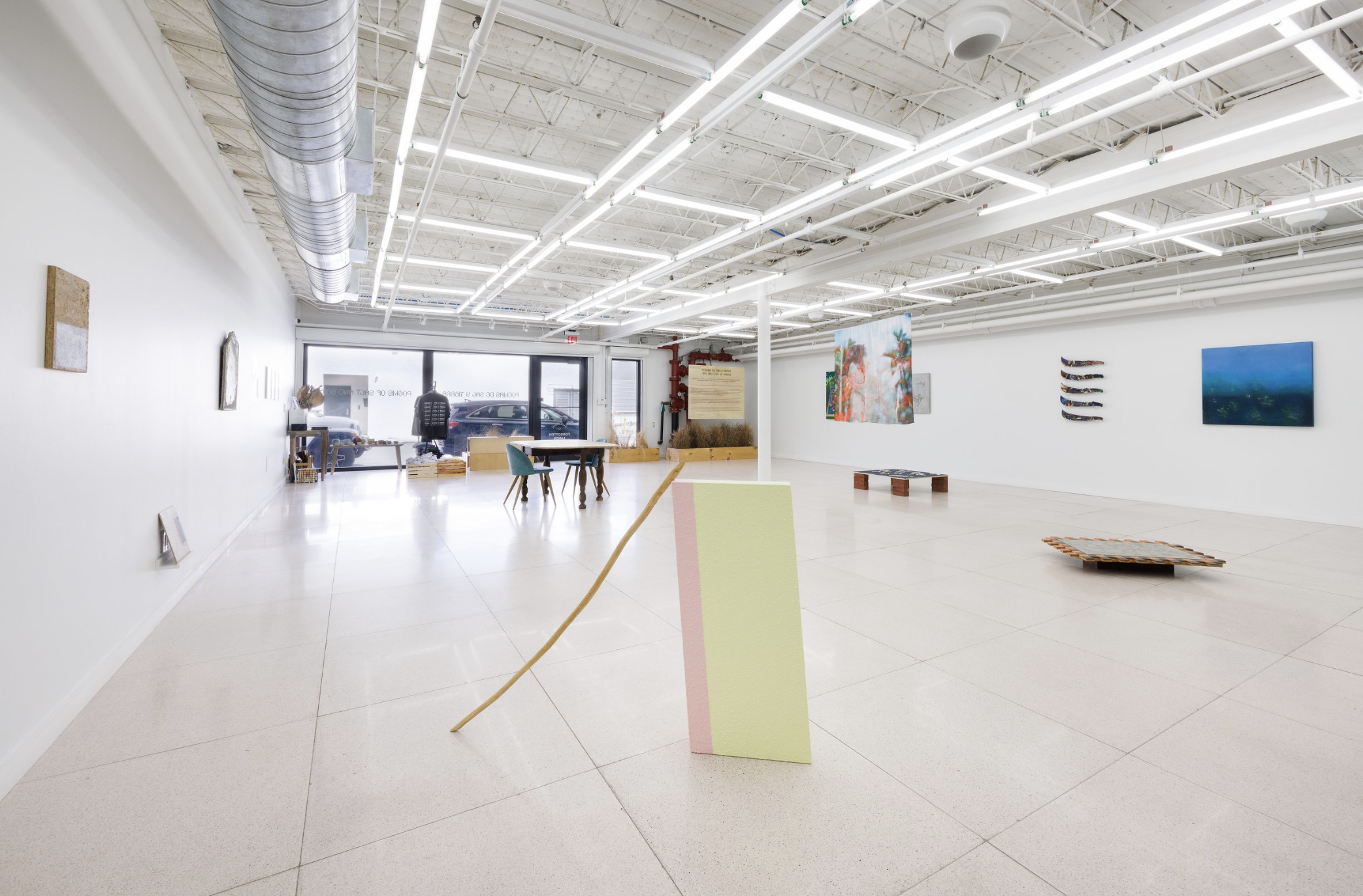
I had the generous opportunity to sit down with Aurelio Aguiló, Mayra Mejia, and Amanda Bradley and have a lovely and abundant conversation at the homework gallery space, where we discussed the many threads and conversations that brought poemas de sal y tierra further to life, the layers of stories that are signified within this exhibition that speak to shared memories, archival cultural intersections, and the many impacts of this collaboration going forward. In addition, the table we sat at during this discussion played a significant role in gathering ideas.
Lauryn: What you guys are speaking to with this exhibition is unique in a lot of ways. I’m curious to hear what the back end of that looked like, how that process came about, and the conversations that led to that.
Amanda: How did we end up at this table?
Mayra: The first thing that happened was that we discovered the book.
Aurelio: Yeah, we saw the FORGOTTEN LANDS book over a year ago. I was just blown away by it because I didn’t know it existed until that moment. Then, I started reading through it and saw that a lot of people I know were featured, so I started following from there.
We reached out since we have our little store and wanted to include the books in our store, but also to explore potential collaborations here in Miami with FORGOTTEN LANDS. That’s how we met Amanda, Cory, and Don. In December, we started the conversation about how we could collaborate. We had an opening in the calendar from April to May, and we began working on the show since then. We each came up with a list of artists we really wanted to work with and then started defining the concept from there. We spent a lot of hours around this table, going back and forth. Some of the artists on our list were included in the show, and we also met many artists whose work we knew but hadn’t had the opportunity to meet personally, which was great for us. That’s the gist of how we got to know about FORGOTTEN LANDS.
Amanda: I had been following homework around Miami when they were nomadic-based. Part of my role and initiatives with FORGOTTEN LANDS involved thinking about how to tap into the Caribbean Arts community here. So serendipitously, when they reached out, it was also Art Week, and Cory was coming down, so there was a moment of a meeting place where we could put faces to names, and I think instantaneously, when we visited them at Untitled, I was like, oh, this feels like family. It just felt easy, and both of our missions are so aligned in the way in which we hope to support artists.
We decided on a show, and we met around this table to discuss what we would create if we were to make a show and why it was important to make that show now. We had already laid out our dream wish lists of artists and work that we thought could be important.
I was thinking a lot about how to hold on to heritage. And even when you’re in a different place and also at this moment in time in America, it feels imperative to make space for artists to deposit, share, or celebrate the pieces of them that stay with you forever, regardless of where you end up in life, whether you immigrate or are first generation. So, that was something that I was thinking about. We all started to talk a lot about that, and we really wanted to think about how to showcase a Caribbean Latin American show without saying, ‘This is Caribbean art.’ Without that blanket of generalization because, we know that that’s not the truth, per se. We really wanted the gallery to be a space where the artists could put personal pieces of themselves into.
The timing of when this was happening and the discussions around creating a show, a lot has changed from the start of 2025 to where we are now, drastically and very fast-paced, but we really wanted someone to walk into the space and feel the intimate moments of the personal.
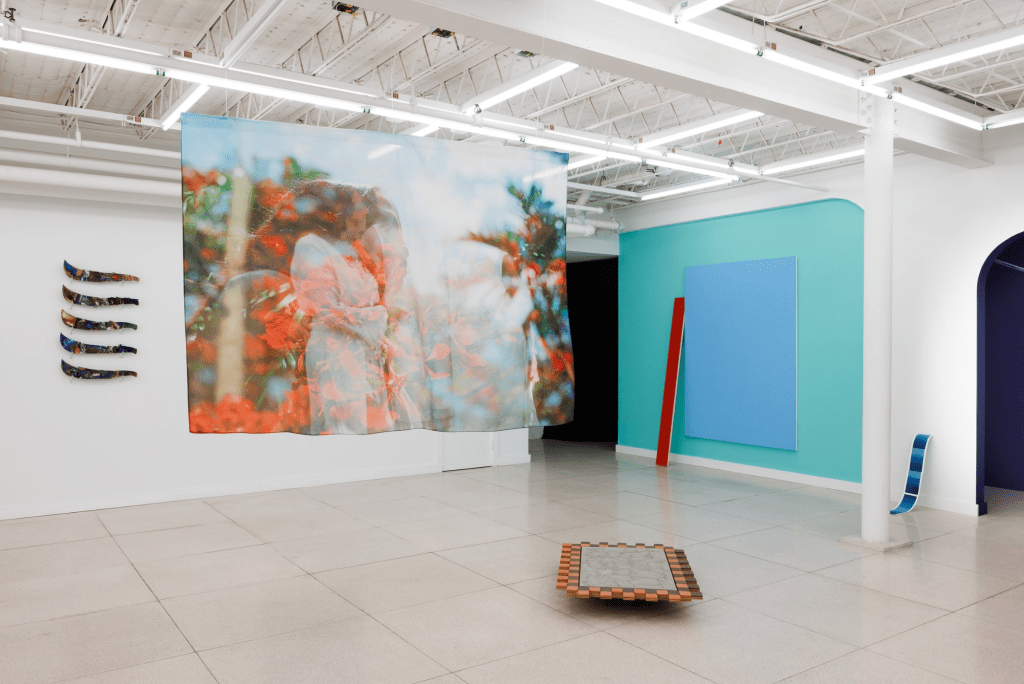
Lauryn: As a viewer, from my experience, it does kind of feel like we are given a window into each of the artist’s personal archives or elements of their memory, especially when we think of the work of Raymel Casamayor.
Amanda, I would love to know what feelings or things have come up for you working on this show, now being back in Miami from Belize?
Amanda: The constant back and forth is always a push and pull. I’m always pulling from place to place. And when I’m in Miami, I’m thinking a lot more of Belize because there is that absence, and so everything I do stems around that duality and that push and pull of ideas of memory and nostalgia. I will say this is one of my favorite shows that I’ve worked on, not just to be biased, but it really felt less like work or less like I was curator and they were artists, or we were collaborators and I really just felt like we were all one of the same community, you know? It was a very co-creative space, both with FORGOTTEN LANDS and homework, but also the artists collectively together in the curatorial layout and the crafting of the text. Everything was so collaborative, and I think curating can be a very isolating experience.
Lauryn: Aurelio and Mayra, were there also personal elements for you that came up as you were working on this show?
Aurelio: The concept of having a living archive was something that resonated with us; as Amanda mentioned, this became the backbone of the show. We spoke with and met numerous artists whose work explores diverse concepts, themes, and art-making practices that don’t typically align with what a Caribbean-focused show typically encompasses. At the same time, it came up in a lot of these conversations. “Everything that I do or express comes through the filter of where I’m from, my heritage, but it doesn’t have to be blatantly out there.” So, we found it to be a beautiful statement and a beautiful way to connect with them because that’s exactly what we were thinking at the same time.
Once we reached that direction, it just became so organic, the way we built up the show, and it became poemas de sal y tierra; it flows like a poem. There are invisible threads that connect each work, and then a visible thread is that the connection to each person’s heritage is there, even though you don’t see it. And visually, at the end, when the works were put up, that thread became visible.
Lauryn: Is there a work or several works in this show that have been sitting with you as well?
Amanda: The work that I knew I wanted in the show, no matter what the outcome, was Raymel’s work, the sound piece. And part of it was that I had heard a small sample of a broader body of work from the Puertos project years ago, just on SoundCloud, and I met him. He’s an incredible spirit and energy to have around. But yeah, we just kept in touch. We collaborated on a few things, but I felt there was this beauty in an invisible medium that was similar to what Aurelio was saying. There are all these invisible threads. Still, there are also invisible mediums that archive and remember and that can trigger future thoughts, present thoughts, and past thoughts. I loved the idea of sound being an integral part of the show. That was before we knew there was also an installation element, but I knew that I wanted part of the show to have this active archive.
But, I mean, to me, that work, as much as it is an archive, is so much also an imaginative space because if you don’t have a relationship with Cuba, or you don’t speak Spanish as your first language, it can also feel like a neighborhood in Miami. I’ve always been meditating on this idea of invisibility. And for me, with that work, I want to give space to something that’s innately invisible and let it take up space, let it encompass space, and that’s precisely what it did.
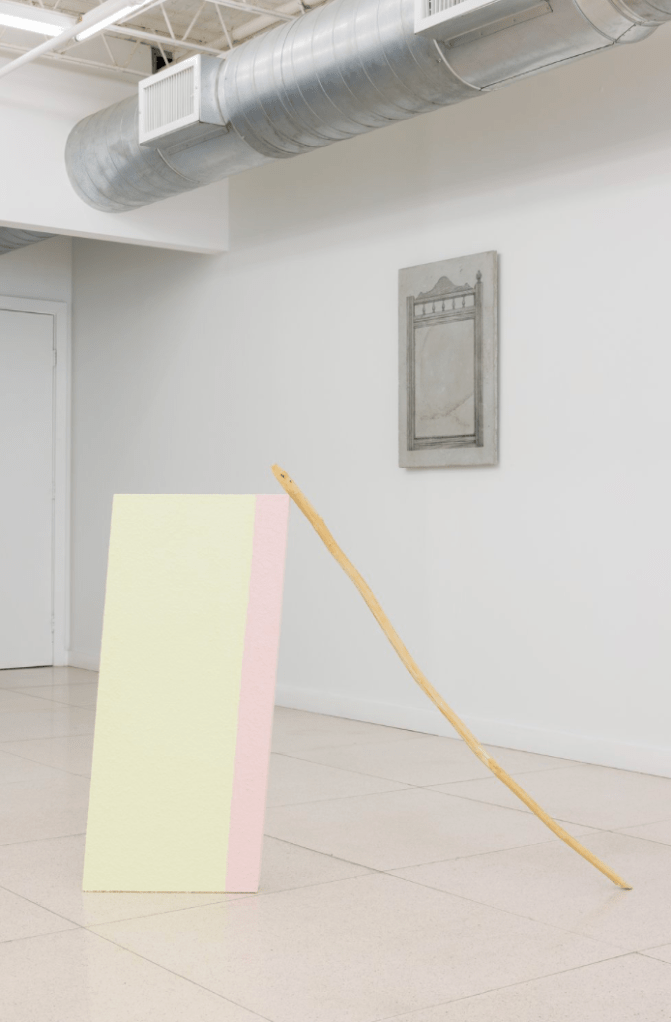
Aurelio: An artist that we’ve wanted to work with, that we did work with in our first show; we showed some small pieces, but we’ve been in conversation for years after that to see how we can make another exhibition work with Charlie Quezada. And there was always kind of a logistical issue with the size of the work. How are we going to present it? How is it going to get here? But I’ve seen his practice evolve through the years. I’ve known him for years. We have a poster of a show he did in Santo Domingo at our house because it was the first show our daughter attended, and she wasn’t even born yet.
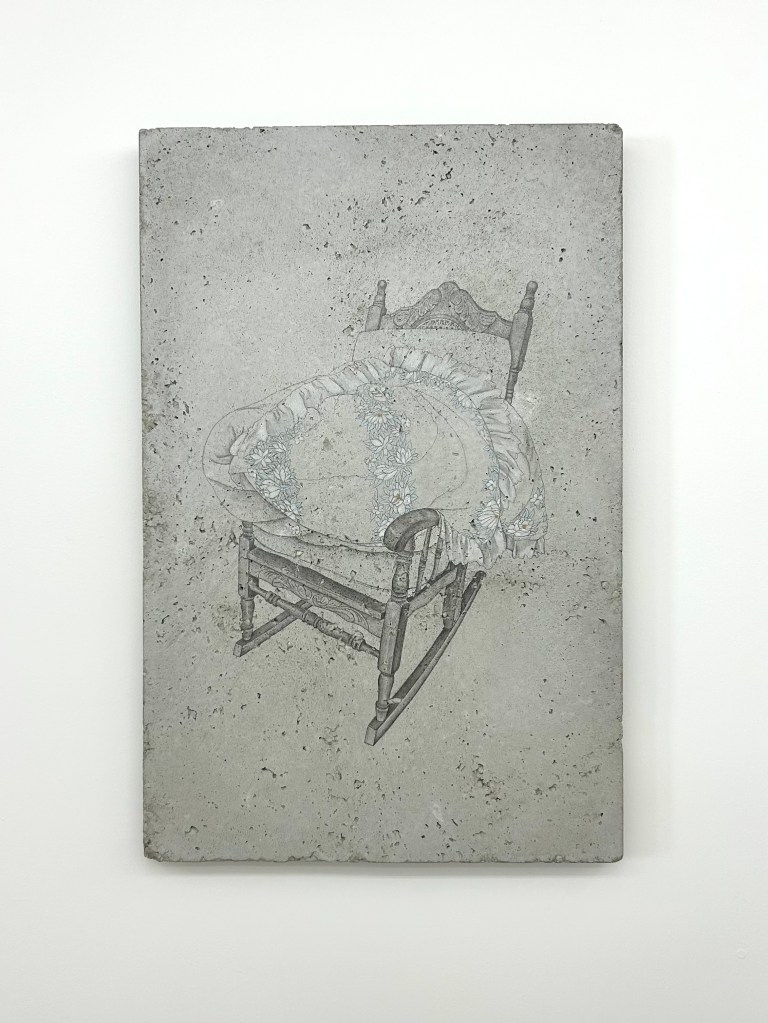
We’ve always had a special connection with his work, and seeing how it has evolved into these now sculptural pieces and minimalist color blocks inspired by the palettes of colors in the Dominican countryside. We wanted to find a way to include his work in this show. So, to have that come to life was a really proud moment.
Lauryn: Has there been any feedback, any words, or any conversations since the show has been open that have aided in the mission of the show or have sat with you since the show has been open?
Mayra: The feedback has been very good.
Amanda: I’ve worked in the arts in the city for so long. And usually by the time I get to a show and I’ve talked to Mayra about this so much, like by the time you get to the opening, you’re just like, let it be over, you know because you’re tired. You put a lot of time and energy into it, and then your body crashes the day of, and that was like the one opening I’ve gone to that I was like, this is fun. It’s to your point that it’s a lot of what they’ve created here with the gallery and the program, like their own curatorial program that they’ve built into the space and their nomadic projects. But I think for me, what’s been really special is just the relationship with the artists along the way.
The reception and feedback have been beautiful for me, even just the process. Writing the text collaboratively has been really nice. A lot of those ideas that came out in the text are things I’ve been thinking about and working with Aurelio on that allowed me to find language that was deep into my subconscious.
I also want to recognize the amount of trust that they put in the partnership with FORGOTTEN LANDS, too, because I felt like one of the team. I really felt welcomed here, and trust is something that we all experience with every artist. There were a lot of firsts in this show, for artists, for the gallery, and for FORGOTTEN LANDS – it’s the first show we’re curating in Miami.
The publications that FORGOTTEN LANDS produces are very much co-authored, similar to this exhibition, which was co-curated; however, it was collaboratively authored. The show is a way in which, like what happens in the book and what is built into the institution of homework, it comes to life. It’s like an unfolded representation of that.
Aureilo: To give it warmth and to be the antithesis of that coldness in the art world that we’ve experienced, it’s been the mission all along to sidestep gatekeepers at the same time.
Lauryn: So, what happens next for you all?
Amanda: I would love to collaborate with them [homework] again, whether personally or with FORGOTTEN LANDS. In the development of this show, like, if you look at our original artist list, I mean, it was endless. Like, there’s no way to put that many artists in a space respectfully. I hope, even if it’s not an exhibition, that we will continue to collaborate and have these conversations simply because of the numerous things and questions that came up around this table.
This show emerged from us asking each other questions and getting to know one another. Similarly, through studio visits that I had and that they had, and then shared studio visits where we asked the artists questions. All those responses, thoughts, and sentiments became what the show is, which is beautiful. But it also is so much bigger than an exhibition. And it feels like its own evolution of something.
This conversation doesn’t end with the show. I think 17 other shows come from this same thought.
Aurelio: Yeah, a living archive. As Amanda said, we initially discussed the show and came up with a massive list of artists for whom we have multiple possibilities to show in the future. We are extremely happy with the way everything came together and the way things are still going; we would like to continue it for as long as possible. We would definitely love to collaborate again.
Amanda: I think there are so many possibilities for there to be multiple poemas in the future.
Something I’ve been meditating on is that we both come from and become the places we move through, whether it be the place we’re born, the place we end up, or the place we build for ourselves.
I think that place is something that consistently dictates sentiments, feelings, and emotions. And yeah, once the title came, I was like, ooh, this is the best fit. And I loved that we could also make it bilingual. Spanish forward, but yeah, to talk about also the area that we’re referencing, you know, and a poem being something that is so personal and so deeply invested in articulating the invisible. Which felt like everything we wanted the show to be.
Lauryn: If we can dreamscape or manifest what the continuation of what poemas looks like, what would that look like for either one of you?
Aurelio: We’re really open and would love to explore the idea of doing it more consistently, including collaborations. I’m not sure if they would be called poemas again, although it’s a great idea. I think the reception of the show, the whole coming together, the collaborative aspect, to be able to do that again in the same context with FORGOTTEN LANDS, that’s something that we’re definitely open to.
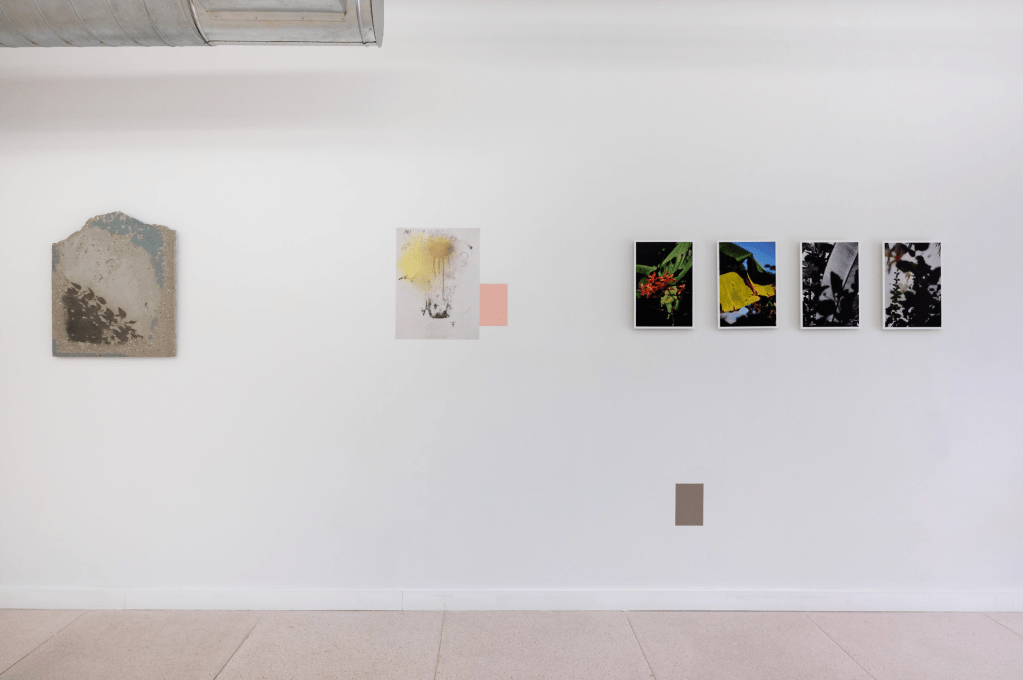
Amanda: One question that I kept asking myself and kept probing at the table was like, what do we hold on to? It’s this idea that even if we don’t feel it or actively pull it out of us, we do hold on to certain things, whether that’s a photograph, an object, this idea of a banana tree, this idea of concrete. Like, for each artist, that manifests in very specific ways, but it always answers the question of, like, yeah, what do we hold on to? And that becomes the archive. Those things, those physical, small elements or things that we take from home to home or place to place when we move or memories that we will not overwrite in our minds because memory obviously changes every time we remember it.
Images courtesy of homework.
Artists featured in the poemas de sal y tierra (poems of salt and soil) exhibtion: Nathalie Alfonso, Stephen Arboite, Elisa Bergel Melo, Jonathan Carela, Raymel Casamayor, Nicole Combeau, Adler Guerrier, Amanda Linares, Devin Osorio, Charlie Quezada and Victoria Ravelo.
About homework: homework is a contemporary art gallery committed to exploring new curatorial possibilities, utilizing experimental art space[s] to host thought-provoking exhibitions that interrogate and broaden conventional paradigms of artistic practice and interpretation.
About FORGOTTEN LANDS: FORGOTTEN LANDS has emerged as a leading force in contemporary Caribbean art, serving as a vital platform that amplifies voices across the diaspora and launches the careers of emerging artists. Our mission centers on illuminating and archiving the often-overlooked narratives of the Caribbean while weaving together the region’s rich historical tapestry.
Born, Bred and Sheddin’ The Souf, a group exhibition curated by Heaven Jones.
Exhibition Duration:
January 18th – February 8th, 2025
Gallery Location:
International Cuts INC, 630 NW 62nd Street, Miami, FL 33150
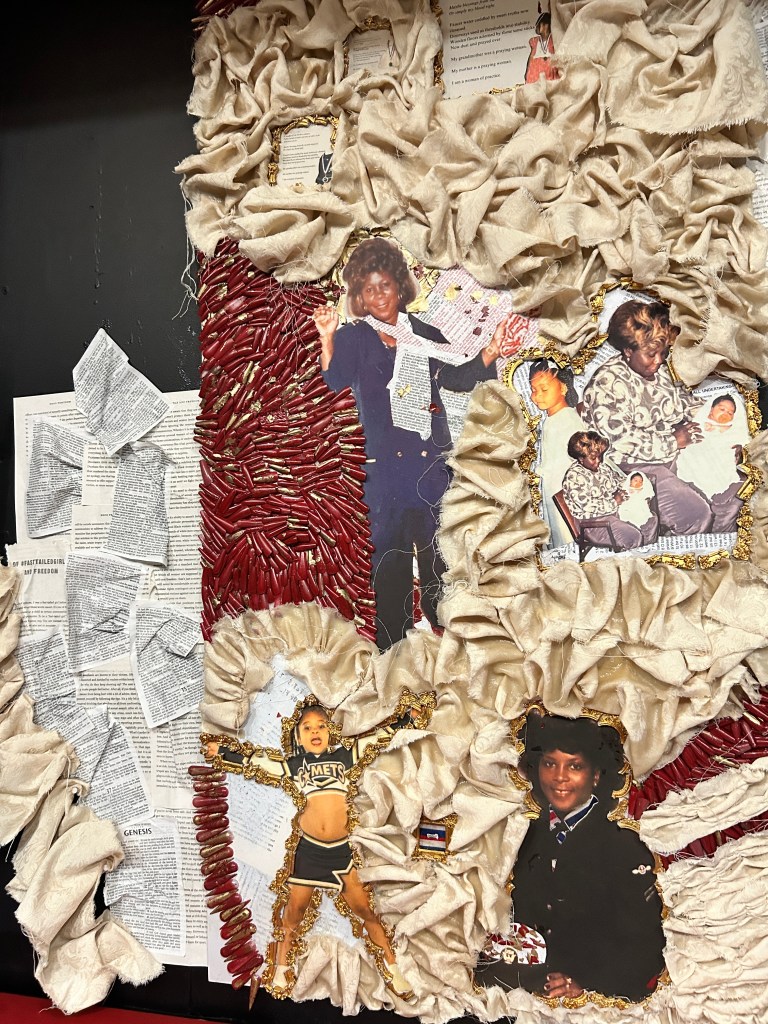
The flow of meaningful, nostalgic conversations and a melodic soundscape greet you as you approach the International Cuts INC salon doors in Liberty City. The salon has been completely transformed and filled with different installations with memorabilia that speak to Southern Black culture and heritage—the melodic soundscape curated by Hii.Rickyy, a contributing artist to this show, included the sounds of Black Miami music designed to transcend visitors to a time and place that holds our memories of growing up in South Florida. The soundscape also served as an invitation further into the space and dialogues surrounding the Black experience in Miami.
The Born, Bred, and Sheddin’ The Souf’ exhibition, curated by Heaven Jones, featured installation-based work by Shayla Marshall and contributing artists Philovian and Hii.Rickyy. Many iconic and unique spaces that speak directly to the acknowledgment and intersections of Black culture in Miami are slowly becoming eradicated through ongoing gentrification. Through the power of community, art, and showing up, many Black and Caribbean communities have continuously worked tirelessly to preserve our culture and acknowledge our experiences over time. This exhibition did precisely that.
One of the unique spaces that encapsulated Black culture and experiences in Miami that unfortunately faced gentrification was the Flea Market USA, which sat in the neighborhood of Liberty City. With its brightly nostalgic blue and red checkered floors, the Flea Market USA contained many businesses run by diasporic communities. It was a place that was always buzzing with excitement and laughter, children running around, men and women leaving salons with new styles, and so much more. 2019, the Miami community had to bid farewell to this historical communal space. Through the Born, Bred, and Sheddin’ The Souf’ exhibition, visitors can reflect on memories of the Flea Market USA and celebrate the multitude of elements that make up Black culture in Miami.
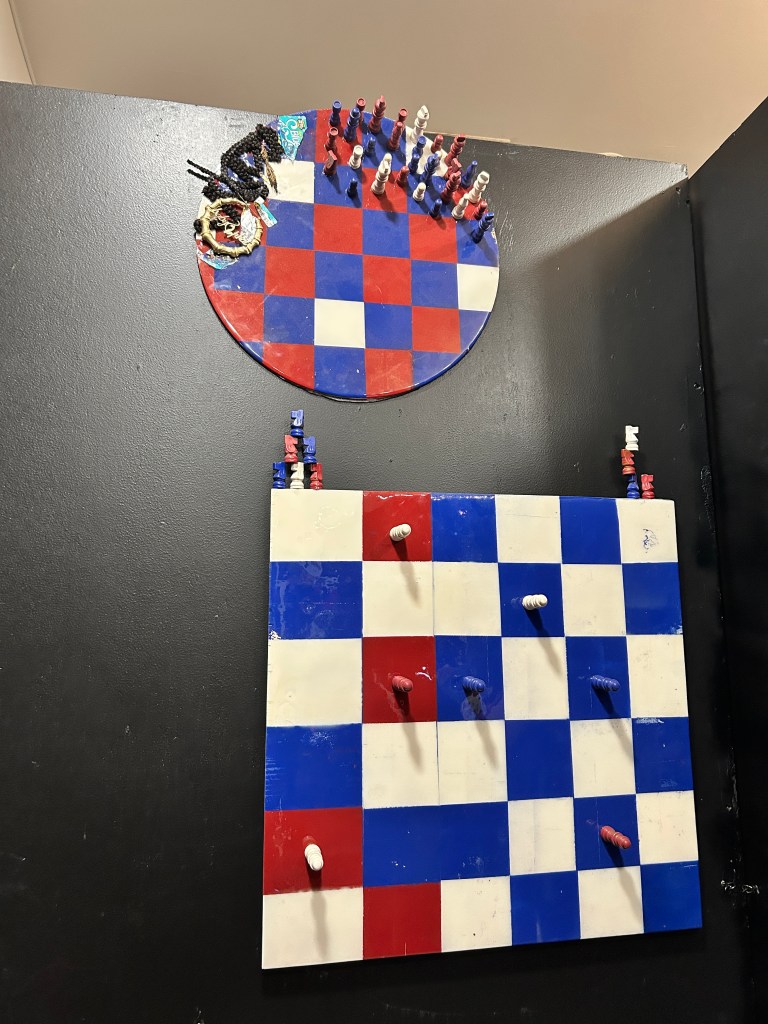
Exhibiting artist Shayla Marshall includes artworks that speak to the Flea Market USA with blue and red checkered motifs, with site-specific elements such as chess pieces, earrings, and hair, which speak to the style then and now, as well as the many consistent items that were accessible in the Flea Market USA.
For the sculpture installation titled Chess Not Checkers: Queen Moves Freely (Vol M), Marshall quotes, ‘Their paintings included in the installation represent the game of chess relating to the game of life. Chess is a strategy game; you must anticipate moves to win the outcome. As blacks, we’re often caught up in this game in life, being used as pawns. These paintings are my way to checkmate. Using my own game of strategies and reclamation to win, showcasing the favor of my people.’
I had the pleasure of speaking with curator Heaven Jones and exhibiting artist Shayla Marshall in the days leading up to the opening. In this conversation, we were able to discuss more in-depth intentions for this exhibition, insight behind the design of the installations, and the history of the space this exhibition sits within:
Lauryn: What do you hope visitors experience when seeing this show?
Heaven: When it concerns art spaces and how we see ourselves, it’s a disjointed thing or a vast gap. So, I want everybody to come through the door and be able to see themselves in every single one of the pieces because when we’re in the studio together, I see Shayla and me and everybody that we met on this journey in each one of the pieces, everybody that comes through can fill a connection to every single thing. So, I’m just kind of excited to see that in a room full of people and bring it into the space, so I want to be a reflection of them in themselves and the world around them.
Lauryn: Could you share why you chose this space for this exhibition?
Heaven: I’m holding this space in my Aunt’s shop. My mom’s water broke in the shop with me. The shop has been around since 1991, and my Aunt is the owner of the business. It sits here in Liberty City. I feel like this community is facing gentrification very rapidly, as well as other surrounding communities. I live in Little River. Little Haiti is facing gentrification, and obviously, Overtown has already succumbed to gentrification as well.
I want to take up space. A constant theme has been that many older women who have learned about what we’re doing keep saying, “You’re no longer asking for permission.” And that is the main thing.
Lauryn: Shayla, do you also have a previously made connection to this space, and what are you hoping as one of the exhibiting artists that shine through your work in this space?
Shayla: I don’t have a connection to this space besides living in the area for a long time. I lived up the street from here, and when I started my creative journey at the Cultural Art Center nearby, Heaven also attended this center when she was younger. It’s also up the street from here, so this area in Liberty City in the neighborhood is a part of home for me.
I work with the idea of third spaces and installation-based works within my practice. This relates to black culture, reclaiming things, and rewriting history and cultural narratives that have been placed upon us. So, my first installation that caught the attention of Heaven was titled Da Crib. It was a rendition of home spaces and the losses of home spaces and black families.
I reclaim these third spaces so that I can bring them back in a new context and light because it almost feels like third spaces feel like when you lose someone that you love, like how we always say that person is always watching over us, energetically, they’re out there somewhere cosmically. They are still around. And as long as you have those memories, people still speak their name. The energy is still around us. My idea of bringing these third spaces back is to reclaim that energy and bring it back to the people, which I feel is my duty.
I’m an artist, and there are a lot of logistics and things that come with being an artist, such as where you show what you do, what you sell, and so forth. But my initial journey, and what is most important to me, is more so being a historian and activist who will bring these things back to life creatively. When Heaven got the idea to me, she wanted to do the concept of Born, Bred, and Sheddin’ the Souf’ connecting to acknowledging items you shed while highlighting grillz, nails, hair, and family T-shirts.
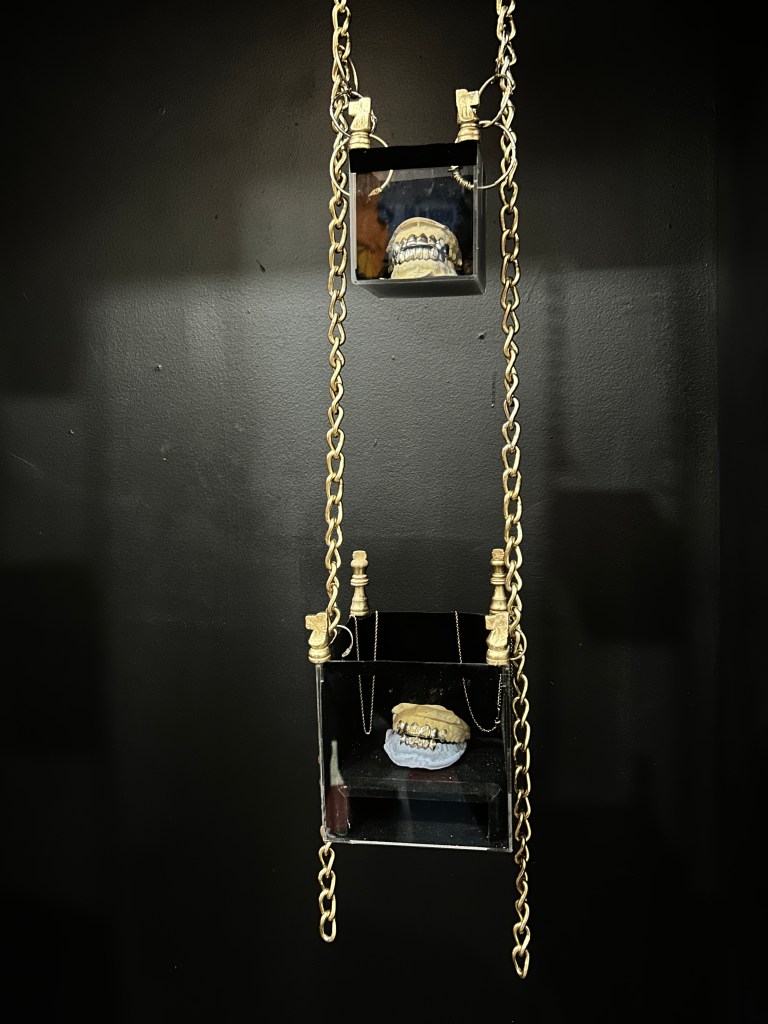
I wanted to do something new for this exhibition and incorporate all of those things. I reflected on how space incorporates all those different things in one. Then I remembered the flea market. Many different flea markets, especially in predominantly black neighborhoods, include many other things. So, it’s an excellent catalyst for those types of conversations. However, we also have the Flea Market USA in Miami, which closed in 2019 but opened in October 1983.
And I grew up going there. My dad always took me there to get his haircut and stuff like that. The other contributing artist that we’re working with is Phil. He’s a grillz artist who comes from a legacy of grillz makers. His uncle invented pullout grillz, his dad brought their grillz practice, Lando Golds down to Miami from New York, and his dad had a booth within the Flea Market USA. We’ve been conversing with his dad as we go to their shop and do stuff like that. So, he tells us stories about how he used to be there, that he got pushed out, and they got a shop now. But their shop is across the street from where the Flea Market USA used to be. Our studio, where we’re working now, is up the street from the shop and where the Flea Market USA used to be.
They tore down a place in the community that used to host performances. It used to have a carnival with this red, white, and blue checkerboard floor. It was this magical-looking, fun place. As a kid, I would always just run around there with a fresh, innocent mind and eyes, and you would see all of these people who are so authentic culturally, like those who never had to conform; they had style. They had the grillz and hair, and everybody was so community-based.
So when they tore that down, it felt like a series of events after that for black Miami, just igniting the catapulting of gentrification. So, I titled this installation Meet Me at the Source, which is the piece’s name because the flea market is one of those places where it’s like a source of culture and community. The Flea Market USA was a significant source for us. So, I’m using this space to have these conversations and bringing that in through installation-based artwork.
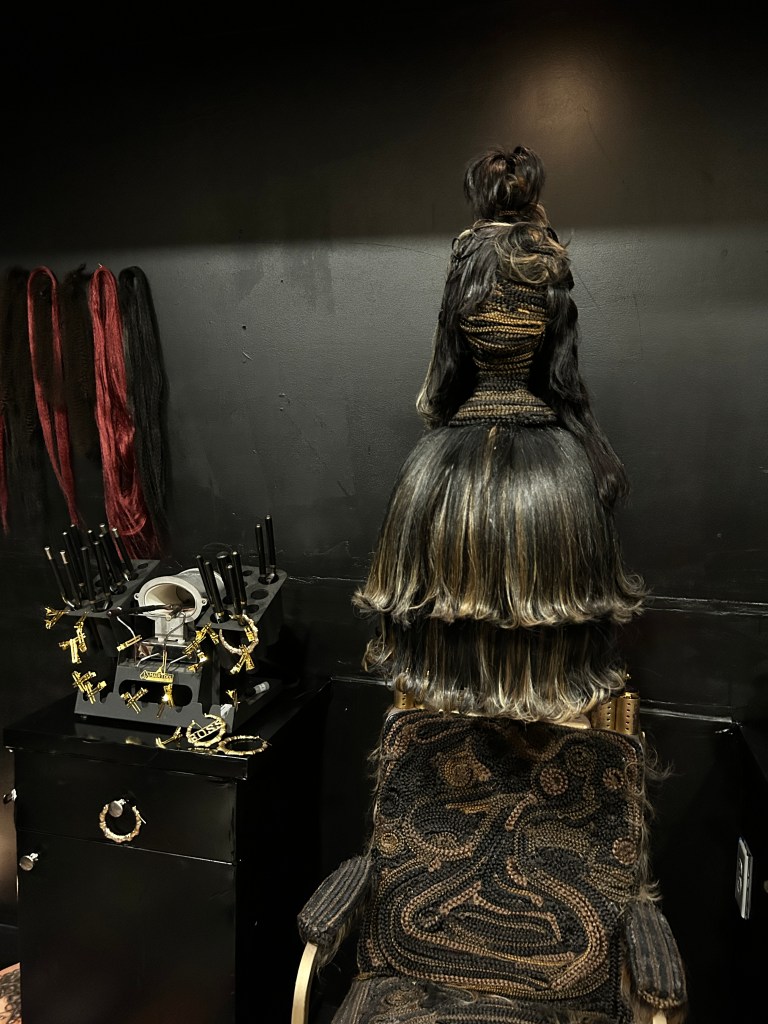
I thought of having a hair-drying chair, but I covered it in hair, cut, layered it, added jewelry and different pieces, and spray-painted it gold. So everything involved in the show reflects what that space used to be, but it’s a rebuilding that elevates it. I hope that people come through and get to see themselves in the work, but the way that I reflect it shines a light that all of these things that people said were ignorant and ghetto are seen as what actually is as intricate and creative as, really something that takes a lot of craftsmanship.
Showcasing it this way and putting so much work into the craftsmanship on my behalf allows people to see themselves and understand what we have going on here as a culture, which is fantastic. I’m glad we get to see it in this way instead of being how society has painted it for us, especially as Southerners because, you know, being from Broward and us being from Miami, the mindsets and things that we have here because of the history of growing up in the South can be a little bit narrow sometimes. We don’t always see the beauty and the ways we show up. My job is to bring that space into light and highlight it in new ways and things of that nature.
And I like the idea of third spaces being a catalyst for me because when I did my last installation, I would bring people into the space and take pictures and Polaroids. I always say that my work is not for the now or social media; it’s for dystopian futures a thousand years from now for people to find because my tintype images last long. With my installations and people finding pictures from those installations of people in the space, they’re looking to history to see what it was or what those people lived like. They would find their ancient African-American artifacts and things like that made by me. Afrofuturism is a big part of my practice, and the ideas and how that reflects on time.
Lauryn: Heaven, what part of your curatorial voice are you most looking forward to shining through with this show?
Heaven: Throughout my 20s, I’ve learned the art of taking up space, and that’s what I want people to do. That’s the continuation of the narrative I want to provide to the public and anyone who walks through the doors. Even through personal conversations that Shayla and I have had, it has always been about taking up space. I always want all of us to go and make our marks. So, I want people to leave here feeling inspired, feeling like, wow, I can make something too. I can do this too.
Shayla just recently went to my family’s New Year’s function. It was a backyard party, typical Miami. My cousin with long locks and grillz is talking about our family reunion that’s coming up, and it’s just kind of like everything that I envisioned is coming into the space but being amplified even more through Shayla’s vision as well with the flea. Everything has been magic throughout this whole experience.
Through this, I’ve developed a residency program, Femme.Continuum, and Shayla was the first person in the residency program. I want to continue to support artists and amplify voices. I just want to continue to develop a space where people can see themselves in multiple places. I want everything to reflect what’s in the now and how I see the women, men, and children around me.
Piero Atchugarry Gallery is pleased to present Women at Large, a group exhibition curated by Dainy Tapia.
Exhibition Duration:
September 21st – November 2nd, 2024
Gallery Location:
Piero Atchugarry Gallery, 5520 NE 4th Avenue, Miami, FL 33137
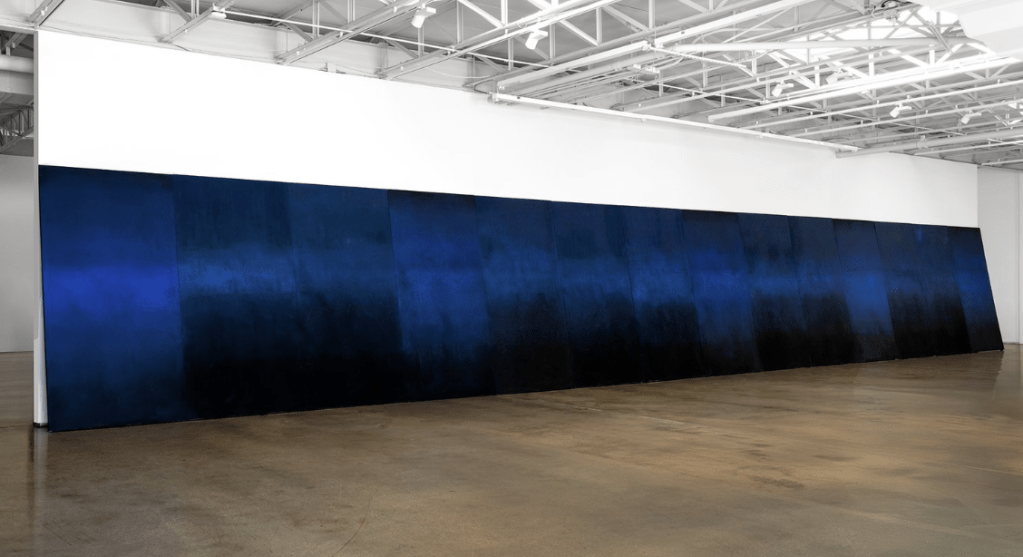
Large ultramarine panels swim towards you with open arms as you enter the Women at Large exhibition within the Piero Atchugarry Gallery in Miami. These panels lay against and dance from one corner of a gallery wall to the next. This work immediately affirmed the title of this show. It informed visitors of what they would witness upon entrance and as they navigated through this show. Thus, visitors will be engulfed in large-scale works created by intersectional women artists.
The artwork LineScape Echoes, created by Nathalie Alfonso, comprises 14 panels connected together in twos, each 96 inches tall and 48 inches wide. This installation takes up much-deserved space and creates an ongoing flow that pulls the viewer in either direction toward further artworks.
Space is the key factor of this exhibition. When we assess the historical and ongoing treatment of women artists within art spaces and reflect on many past women-led shows, there has always been a consistent lack of space. With this show, curator and founder of ArtSeen365, Dainy Tapia, does an excellent job creating space for these towering and massive artworks.
This exhibition is the third iteration of Women at Large, which started with the premise of providing ample space for a group of women artists to present large-scale artworks.
Each artist was encouraged to take up as much space as possible with their new experimental work or previous significant work they decided to present within a different context. Thus, allowing viewers the space to take in each of these tremendous artworks fully.
I had the extraordinary opportunity to have an in-depth conversation and walkthrough of the show with curator Dainy Tapia, in which we discussed the evolution and impact of women-focused art exhibitions, the challenges, and successes of organizing shows for women artists, highlighting the importance of providing ample space and opportunities. In addition to unpacking the physical and logistical efforts required, site-specific works and intuitive curatorial efforts essential to foster creative freedom and community engagement.
Lauryn: You mentioned to me previously that this exhibition is the third iteration of its kind. Can you tell me a bit more about the history of these shows? And what makes this show stand apart from its predecessors?
Dainy: I was collaborating with the Doral Contemporary Art Museum and wearing many hats, not necessarily working, but supporting. But in 2021, they got a space, and this was at the CityPlace Doral. Marcelo Llobell, Director of DORCAM, sent me a video of an empty space. This is a plaza-like ample commercial space. It was almost March, and he said, ‘This can be utilized for women’s month.’ Then I’m thinking, if I could do something this time, I think it would be better to do fewer artists, but more space, and give more space.
Lauryn: That’s such an exciting conversation because we’re talking about women being able to be in spaces and make up the space.
Dainy: Exactly. That show happened very quickly, and I only tapped into 10 artists. There was ample space, and the idea was to present large-scale works because the same group of shows also found it hard to combine large-scale artworks. Sometimes, you have a group show and a couple of large and smaller works. But then that was a pretty simple premise; that show was called South Florida Women Artists at Large because there were artists from Miami and some from Broward.
Lauryn: I love that you incorporated women from both Broward and Dade. I think I’ve noticed that there is still that divide, which is interesting because we’re all in South Florida.
Dainy: And there shouldn’t be that divide. So, that show came out very nice, if I can say so myself. It felt good, and based on that show, the director of LNS Gallery in Coconut Grove, Sergio Cernuda, had asked me one day while I was visiting the gallery, “Would you be open to bringing that women’s show to the gallery?” And I couldn’t believe it. So, we did that.
At the time, they [LNS Gallery] represented three local women artists. So, the idea was to invite the women who were part of the previous show, incorporate the women from LNS, and we even had a chance to ask some other artists. So that show had 17 artists participating, which was a lot, and we worked on it for about a year. Maritza Lacayo from PAMM wrote a beautiful essay about women; women in the arts coincided with the overturn of Roe vs Wade. I mean, it was momentous in that sense.
Then, I applied to The Ellies from Oolite to do a third show with that idea. The show at LNS wasn’t complete when I applied, but it was already in the works. So, I thought it would be great to do it in different locations. We learned so much from that experience of doing it at a gallery versus doing it at a non-profit institution because the galleries have a different perspective, right? Like how works have to be prepared and how they have to be presented.
The second iteration, In the Company of Women: At Large, was held at LNS Gallery in 2022. The gallery had a central room for that show, almost like a project room. We utilized that room for Karen Rifas, an artist with a long trajectory working within the community. It felt super nice to give that unique space to Rifas and honor her.
So, we really valued the idea of a multi-generational show for that second show. Artists at different points in their careers, but always including an artist with a lot of engagement with the community, almost to recognize that. In this third iteration, the artist is Charo Oquet.
I received the Ellies Award and utilized it for this current show. The artworks in this show are so diverse. In reality, I was tapping into artists I was curious about, and I felt like there was something about their practices that I wanted to see more of. In many ways, the artists within this show created artworks that launched new conversations.
Lauryn: Given your prior conversations with each artist in this show, did you already know how you wanted to arrange it all within the same space?
Dainy: I put together a digital mock-up. I’m talking with each artist about their works and ideas, but many of them are new, and some were created here. For example, Carol Jazzar’s work didn’t exist until she finished it in this space.
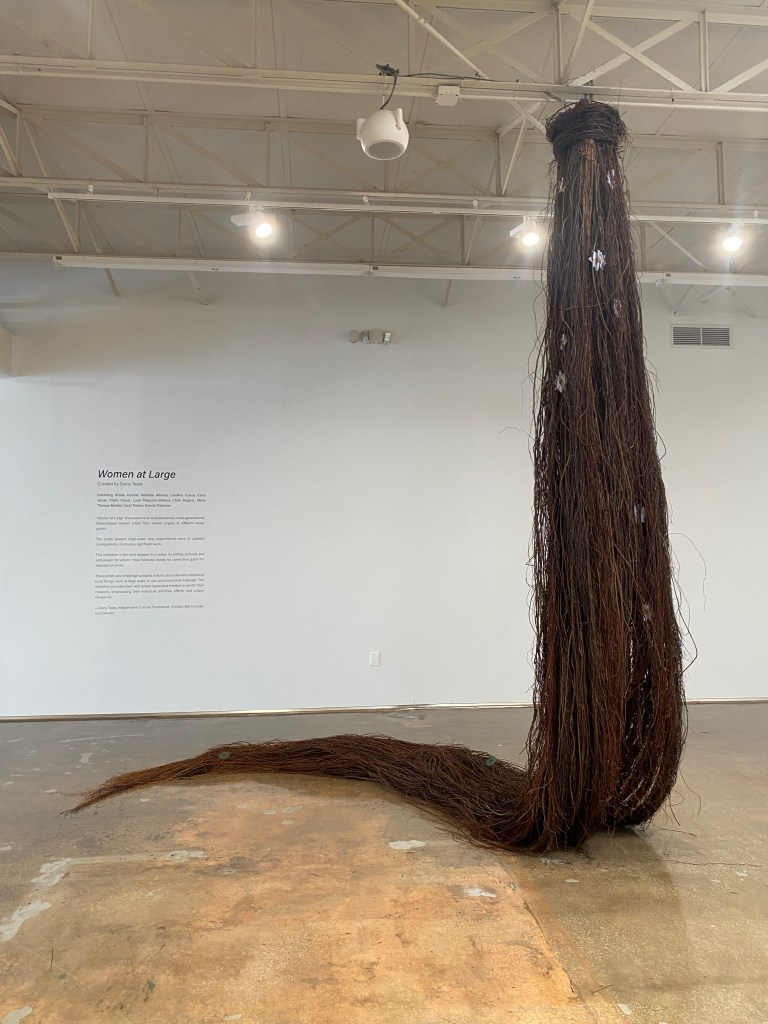
Lauryn: Interestingly enough, this work captivated me as soon as I turned the corner, and it also made me wonder if many, if not all, of the works here were created site-specifically for this space.
Dainy: So, Jazzar’s practice is within photography and has always focused on nature. She’s interested in nature, both in the environment and human nature. So, she does many things that have to do with astrology and the inner self. She has some beautiful collages but has been doing these installations using a natural element, like branches. Then, she inputs photography elements to invite you to look further. I wanted her to do something along those lines. That’s the only prompt I gave her, but she had this idea.
These are Banyan roots; she had this idea, but then doing it was a whole new, different thing. The photography element of the work is included in the small-cut flowers within this installation. For her, the photography part is very important because this is what she had been exploring—photography in a way that almost distorts how one may look at images.
Lauryn: And I feel like what I’ve noticed just from my walkthrough is that each work, in its own way, kind of enters this conversation about femininity and masculinity, but in ways that kind of distort the concepts of it that you may already have. And I think it’s fascinating because they all are, in a way, having these multitude of conversations with each other.
Dainy: When thinking of all of the works, after choosing and, of course, after bringing them together, what attracted me to do all of these propositions besides size was also giving them the freedom of choosing. All of the artworks have a physical component, a physical labor, an edginess, and sturdiness.
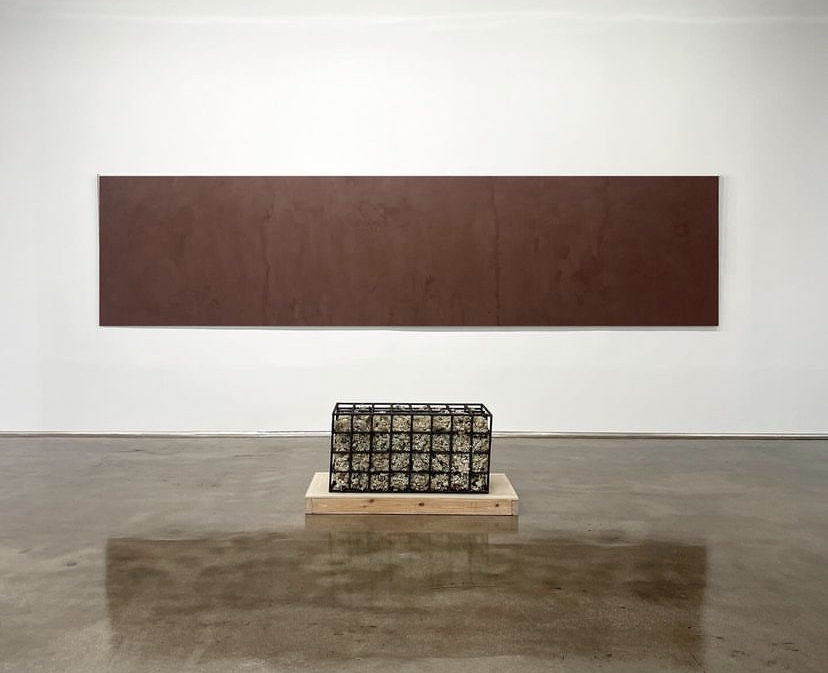
Dainy: The work of Luna Palazzolo also works with materials that are not necessarily the most common elements within art-making. She sees the painting as an Underpainting, which is the title of the painting artwork within this two-part installation. This is the first time that Palazzolo, a painter and a sculptor, has been working with rebar. This is something that she made herself very, very labor intensive, too, and at the same time, combined with the dry flowers, that almost talks about femininity that is contained. When this work was installed, it brought a lot of grounding to the room. It flowed beautifully in conversation with other works, such as Jazzar’s installation. Flower elements are always so feminine, but both of these artists’ flower elements within their work are very different and are having other conversations.
Lauryn: And beautifully enough, these artworks have the space to allow that. I think what already intrigued me so much about the show, and also want to reflect on it, is how this idea of having space to show this work and the capacity where it allows each viewer to have a different conversation with it and then move on to the next.
Sometimes, with group exhibitions that are a bit tighter in terms of vastness and space, it’s kind of hard to notice those dualities because you’re digesting something else at every single corner you turn. So, I’m really glad that you were able to utilize it in this way, truly to work.
Images are courtesy of the Piero Atchugarry Gallery and Lauryn Lawrence.
Supermarket Gallery is pleased to present Abuela’s House, a solo exhibition co-curated by Zee Lopez Del Carmen.
Exhibition Duration:
September 16th – 28th, 2024
Gallery Location:
Grand Opening Gallery, 2242 NW 1st Place, Miami, FL 33127
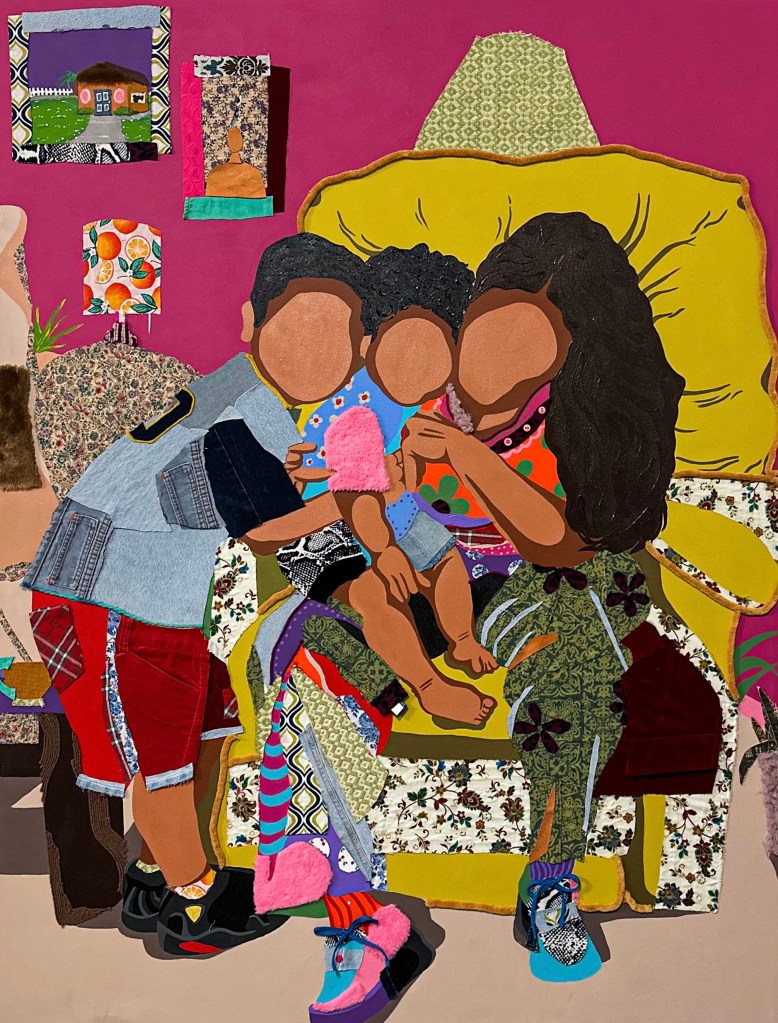
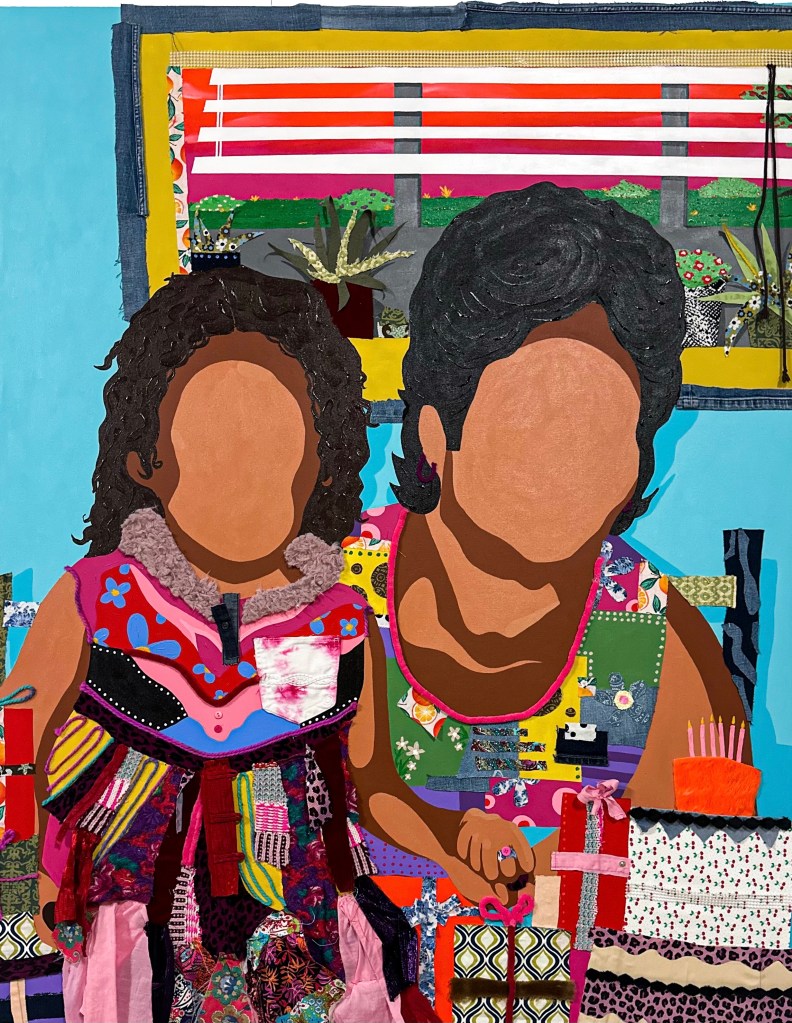
Eruptions of laughter, tender rivers of words, and splashes of vibrant colors embrace you as you enter the opening reception for Destyni “Desi” Swoope’s solo exhibition titled Abuela’s House. The exhibition takes place in the Grand Opening Gallery that resides in a nook within Wynwood, but once you enter the space featuring installations that contain small framed photographs showcasing Desi’s family archive and memories, objects such as hair-rollers, a sewing machine, and a fly swatter transport you to Desi’s Abuela’s house.
In artworks such as Warm Embrace, though the figures appear faceless, viewers can interpret the figures as representations of people within Desi’s family due to the presence of familial archival photographs of a young Desi and members of her family.
What is so prevalent within each painting is the intricate way that Desi intersects a variety of materials and textiles to engage in a conversation surrounding the preservation of her memories, the acknowledgment of her identity, and the celebration of her cultures. These elements translate so fluently as I overhear guests discussing how the work speaks to their ancestry and heritage in a way that makes them feel at home.
What is also prevalent within this show is the genuine and tender collaboration between the Supermarket Gallery team, curator and cultural researcher Zee Lopez Del Carmen, and Desi. From the introductory text, the curatorial decisions regarding artwork placement, the yellow accent wall, and how they all talk about the work. I had the opportunity to converse with the co-curator of this show, Zee Lopez Del Carmen, and the founders of the experimental and artist-led Supermarket Gallery, Maria Gabriela Di Giammarco, Mario Andres Rodriguez, and Jahi Khalfani before the opening reception.
Lauryn: I am curious to know how the Supermarket Gallery came about.
Maria: The Supermarket Gallery came about initially through Jahi and I having a bunch of mutual friends in Gainesville. I went to school there, and Jahi has spent a lot of his life around Gainesville, and we ended up linking up at a mutual friend’s show. Fast forward to maybe a year or two later, he came to me with a project idea, which ultimately didn’t come to fruition then, but the Supermarket Gallery ended up coming out of that. I brought Mario along because we started an independent curatorial practice together outside of our gallery job.
Lauryn: What was the process of working with Desi and initially curating this exhibition?
Zee: With Desi and Abuela’s House, it was a serendipitous moment, which is what this entire collaboration and exhibition has been. I reached out to her on Instagram because I had been looking at her work from afar, but still from home, being here in Miami.
We kept passing each other, but I said to her, ‘I really just want to go into the gallery, into your studio, sit with you, and see what’s going on.’ We didn’t have anything planned. We didn’t have any conversations that had been pre-set. I didn’t send her any questions. I walked into her studio, where she had this wall covered in art pieces, which I would inevitably find out were the pieces for the collection of Abuela’s House.
Lauryn: How are you all navigating that concept of comfortability within a gallery as a new space and working to target different audiences with Abuela’s House and shows to come? How are you guys working as a space to create that comfortability, where viewers and audiences are getting to know the work that you guys have done but also feeling somewhat at home?
Mario: That’s a great question because it is something that we have very seriously considered as one of the tenets of the Supermarket Gallery from before we even had an exhibition to show. There were countless nights when Jahi, Maria, and I discussed this.
We want to be different from other galleries. We want to be more accessible. We want to be more approachable. We want the art to be at the center, but we also want it to come across in a way that would not intimidate or turn its nose up to anyone, especially not people in the local community.
Both of the artists that we’ve shown thus far, even if they’re not originally from Miami, their work resonates with Miami, and it resonates with Caribbean and Latin culture across the board because it’s scenes that we’ve all seen intimately just from living our lives, either in the diaspora or in these different countries.
Jahi: I agree, and I just wanted to say that for the three of us, Zee included, the way that we operate and care about one another and people from the outside is kind of at the core of how we operate.
It’s very innate, and that comes across in a lot of different ways, especially when it comes to working with an artist like Desi, who is very proactive and has a clear vision, purpose, and intention behind the work where everything gels together to where it’s a partnership. We’re here to help complement the artists in the best way we can.
Maria: We’ve been really blessed to have two artists at this point. And this extends specifically to Desi, a person with a very clear vision who is uncompromising. It becomes almost liberating, rather than restricting, to let the artist stay at the helm of what we’re doing.
Lauryn: Is there anything specifically that you all aspire to be communicating through certain interpretive models with this show?
Mario: I hope the first thing that translates is the tenderness because that’s a big part of the work. The intimate love for her family, specifically her grandmother. To me, at the core of this is the reclaiming of her ancestry and the ties with her grandmother. Especially in the statement writing, there’s a lot of tenderness to what we wrote.
Zee: I think if there’s anything that we have altogether as we’ve gotten to know her more, seeing her personhood extend into her creativity, I hope that the influence from that comes for people to take a moment to sit and think about the ordinary in their everyday life and think about the things that we take for granted, the living memories we take for granted, and how that could become our everyday living archive that influences who we are, who we’re becoming, but that also permits us to evolve from that.
It doesn’t necessarily mean that we are turning our backs on, but what does our ancestry look like, and how does it build us up to be and give us the tools that we need to carry ourselves on today, which is, I think, one of the most vital things that Desi has taught all of us.
From the beginning, every single day, it has been such a beautiful experience, and that’s why I want to add to what Mario said about tenderness because that’s what I hope people do walk away from.
There is an everyday tenderness, evolution, self-agency, and looking at your living memory and being able to carry that as a badge of who you are and to be able to use that also as the permission to show people who you are today and who you want to be tomorrow.
Desi has shown that to us, and now she’s inviting her family into such an intimate space for herself too. I don’t want to discount that, this is about her family, but at times she’s mentioned, ‘I don’t think my family even knows what I do. They understand the aspect of a creative, but I’m really inviting them into my world and how I see them alongside how I see myself.’
I hope everybody that comes has that moment of reflection, where they completely forget that this is not their family home; that they turn around and have that same experience of almost like a homecoming for themselves, where they’re like, I have stepped back into what has made me who I am, and I need to take a second and look at these little symbols and these icons of my family that maybe I just brushed off, but that reminds me that I always have a place to go from and to stand upon when somebody questions me or when I question myself.
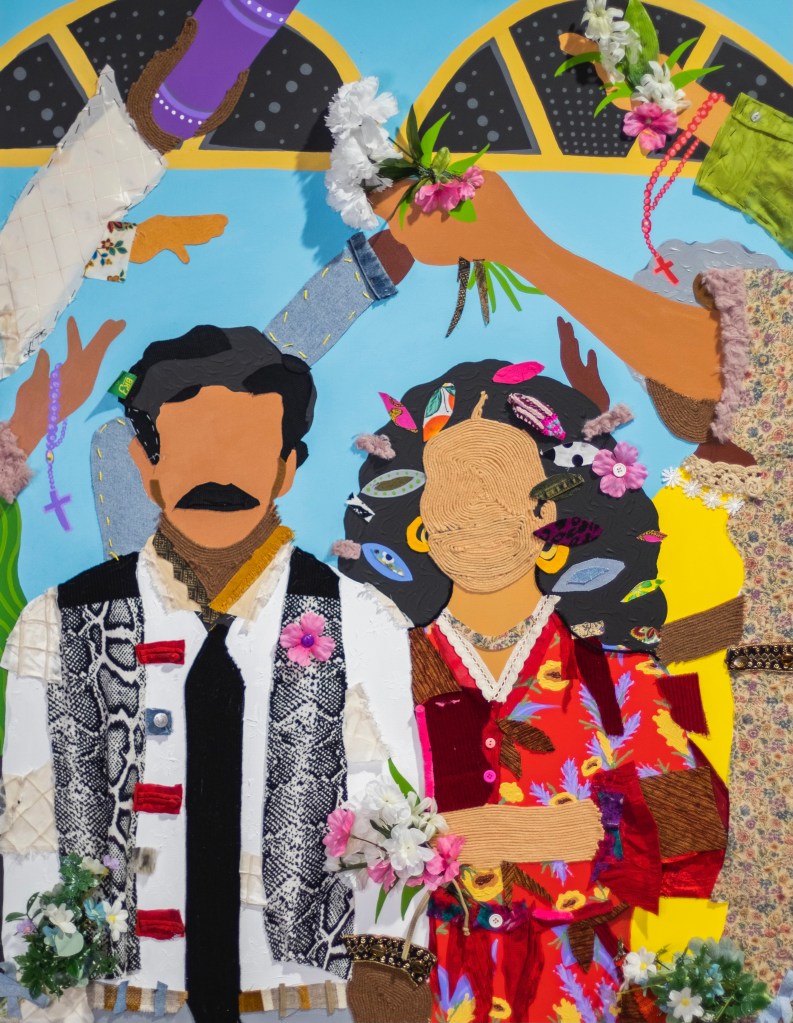
I was also able to speak with Desi before the show and ask if there were any artwork(s) in particular that led to a shift within her practice and if there were any translations she hoped for the work to communicate.
Desi: I wouldn’t say there is a particular piece that led to a shift for me. Abuela’s House as a whole, the entire body of work is a shift. Going from doing mostly commercial work with brands, other artists, and businesses. Abuela’s House being my first solo show and an entry point into the fine art space, the whole body of work is the shift.
This shift happened when I stepped back and took a moment to ask myself some honest questions. A lot of these questions involved who I was regarding roots, heritage, and culture. How much did I really know about myself? How much did I allow myself to forget? What core memories and building blocks am I forgetting? And if I’m not forgetting, I need to dial it back and think about why I am the way I am.
Why do particular colors stand out so boldly to me? Why do specific patterns tell such a story to me? Why is looking at a sewing machine reminding me of my Abuela? Why is seeing a crochet blanket or outfit reminding me of my Abuela? Why does smelling coffee remind me of my Abuela?
For me, it was in all of these little moments and things that I kept questioning. Then it came to me. There’s the intention here. This questioning is not just happening because I’m having a manic episode. This is me getting down to the bottom of who I am. It’s about discovery. It’s about remembering. It’s about preserving all of these things because they make us who we are. They made me who I am, and that is the shift.
The story-telling part is talking about my Abuela, my life, and my experiences with her, but it’s also about holding on and championing these moments and conversations. I do hope that within the theme of this work, what translates the most to people who view it or read about it is taking the time to sit back in this fast-paced world and really reconnect with your roots and hold on so tightly to these things because they are what makes us who we are.
We have so many moments where we can all sit down and easily acknowledge our traumas and things we need to heal from. I feel that we also deserve moments where we can sit down and list the beautiful things that make us who we are, the beautiful things in our history, and the beautiful things in our heritage and roots. The things that uplift us and make us vibrant, the things that really create the essence of who we are.
All Images are courtesy of The Supermarket Gallery.
Girls Club is pleased to present What Is Seen, a group exhibition curated by Tayina Deravile.
Exhibition Duration:
August 30th – October 4th, 2024
Gallery Location:
Girls’ Club by the River, 330 SW 2nd St. Ste. 102 Fort Lauderdale, FL 33312
Large vast windows wave at you with an invitation to get closer to artworks bustling with intricate techniques and unique narratives. This is the path leading viewers into the vast Fort Lauderdale contemporary art space that is Girls’ Club.
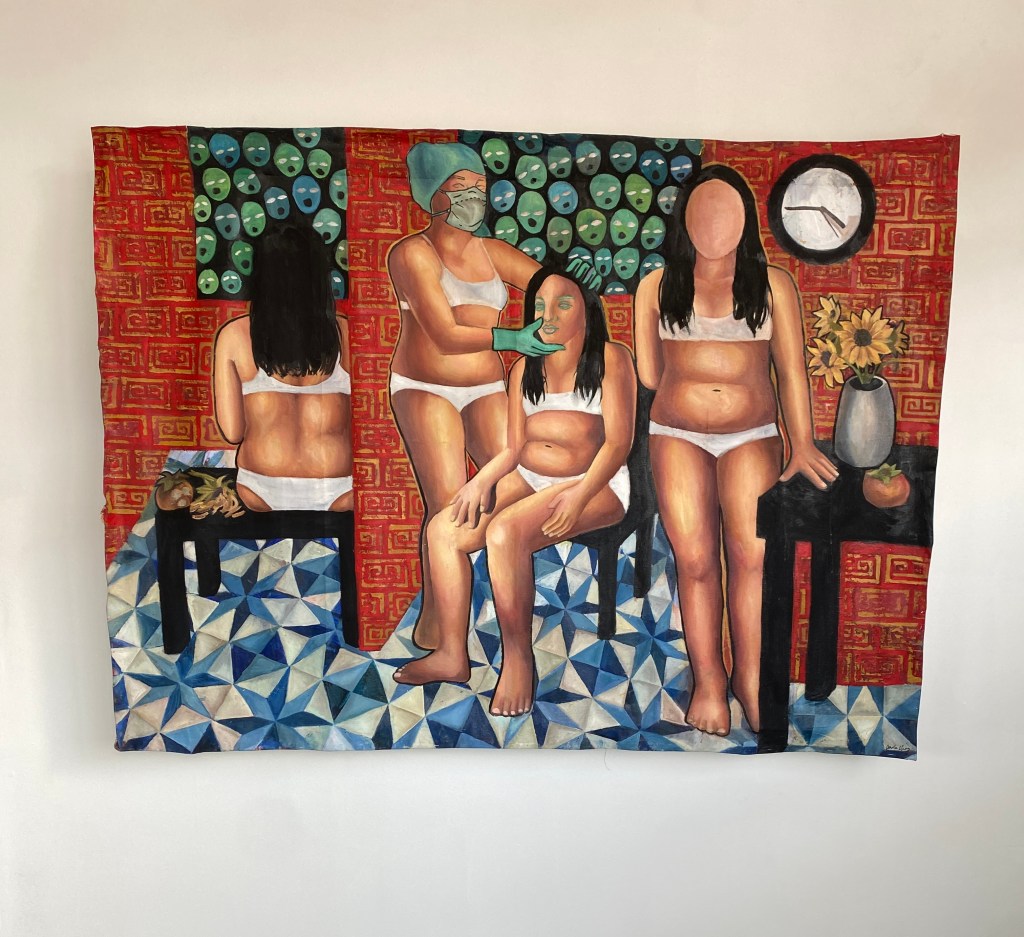
The title of this group show is What Is Seen, where curator and gallery manager of Girls’ Club, Tayina Deravile presents recent acquisitions from the Girls’ Club collection as well as artworks from the collection that have yet to be seen. One of the artworks that caught my attention immediately and in many ways encapsulates the title of this show is The Waiting Room (east to west) by Caroline Zhang.
In this artwork, four semi-nude figures appear faceless, with their back turned, or even covered in masks. In many ways, this method led me to question what is it to be unseen, hidden, or invisible. What are the roles of some of these faceless figures? What is it to be seen? How can portraiture challenge this idea of being seen? These questions guided me further into the show with great curiosity and admiration for how each of the artists in this show expanded on the reconfigurations of portraiture.
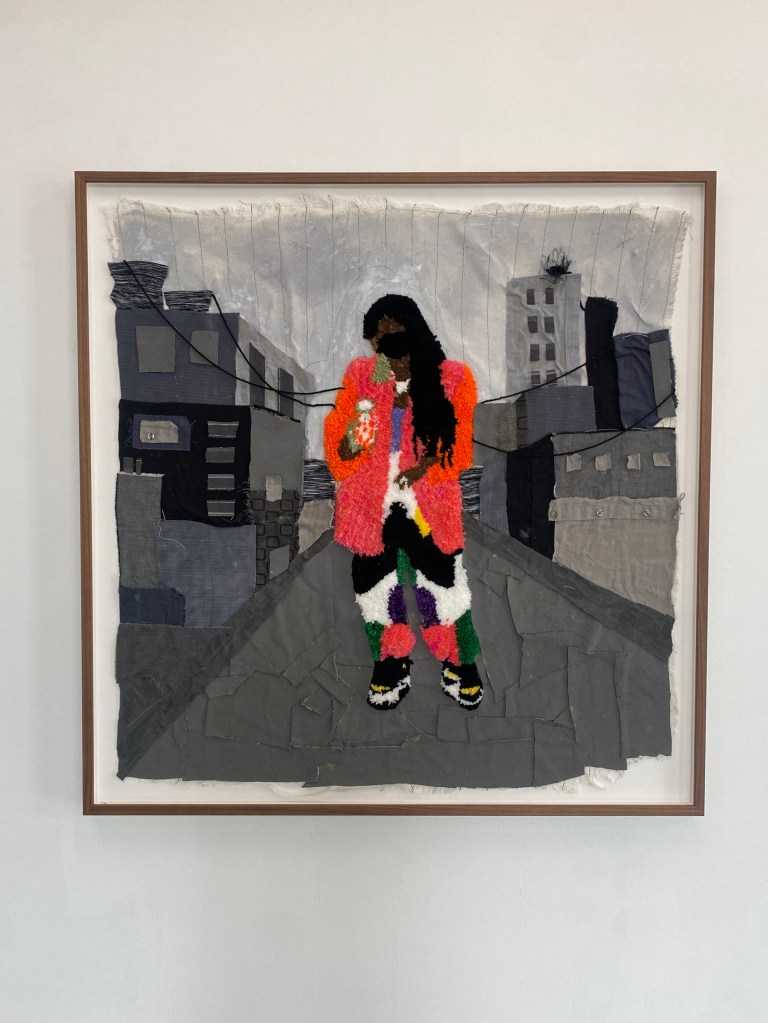
Another artwork that engages greatly in dialogue with Zhang’s piece is a large multi-media portrait titled, Stepped On by Kandy Lopez. Similarly, the figure within this portrait also appears to be faceless or wearing a mask in a way that leaves no room for recognition of who this figure may be.
I’ve had the pleasure of getting to know Lopez over the years, and it has always amazed me how her work has such a captivating way of inviting viewers further into the world of the figures she depicts.
Lopez has such a unique way of manipulating a multitude of fabrics and textiles to bring the essence of her figures further to life. The way she is able to turn threads into pigments and incorporate so many different materials has such a unique way of challenging the way we look at portraiture.
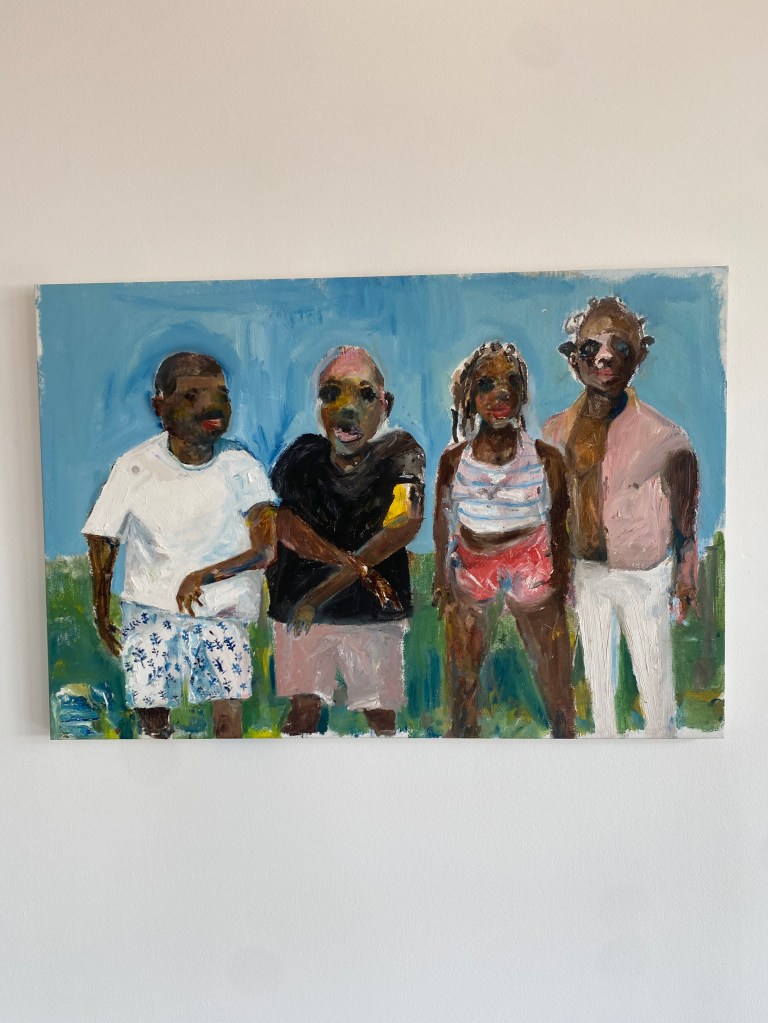
An artwork within this show that also helped guide me through this idea of what it is to be seen and how portraiture can challenge that is a painting titled, Fo the Park by Jared McGriff. In this group portrait, four figures are depicted in a loose painterly manner that adds this layer of movement and energy to the piece.
In many cases, there is always a sense of stillness within painterly portraits, whereas, with McGriff’s Fo the Park artwork, viewers are granted this moment of peeking into the identity of these figures while acknowledging the essence of their movement. This artwork granted me a moment to reflect on the simplistic practice of getting together with your community and showing up for one another in any capacity that leads to so much further movement.
Overall this show does such a great job of not only allowing viewers to witness some of the incredible works within Girls’ Club’s collection, but also in how it challenges how viewers interact with different perspectives within the realm of portraiture.
What Is Seen is a show where one finds a sense of reflection of oneself in every portrait, where one is able to witness the multiplicity of intersectionalities present within one space.
Kennedy Wilks presents Landfish, a solo exhibition.
Exhibition Duration:
7 – 9 June 2024
Gallery Location:
FILET Gallery, 103 Murray, N1 7QP London
It’s not often that I walk into an exhibition space and immediately feel wrapped up in a cloak of comfortability and nostalgia. It was the slow thump of the reggae music that played in the background, the vibrant colors that danced around each canvas, and the warmth exuded from those within the space. This particular experience resulted from entering the intimate FILET Gallery space showcasing a body of work produced by Kennedy Wilks.
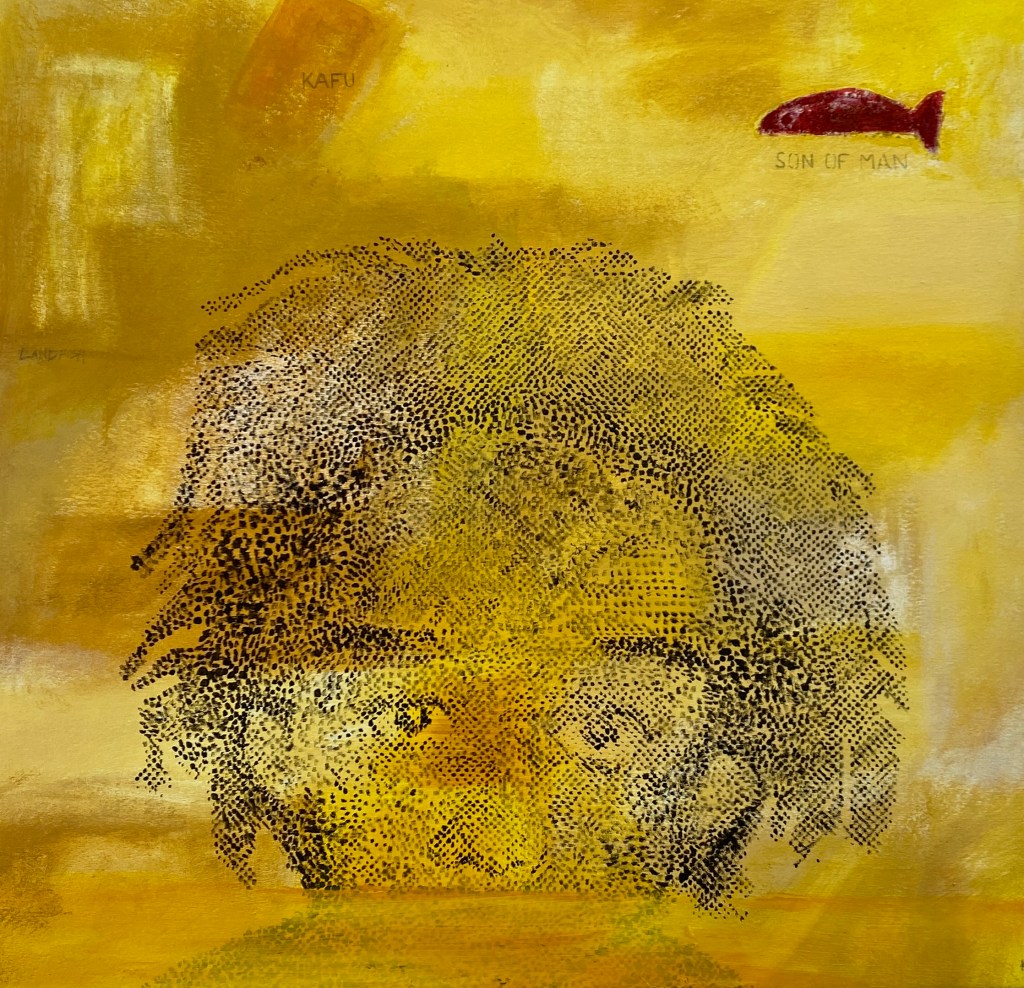
One of the first artworks you are greeted by is a magazine article that features an interview in which Wilks describes to the interviewer a bit about his background as a creative of Caribbean descent living in London, the many influences from all the cultures that he encompasses that seep into his work and so much more. This interview almost functioned as an introduction text label, and it truly worked. It allowed the viewer to learn who Kennedy Wilks is and how most of the works on display came to life, while leaving still much up to the viewer to create their interpretations.
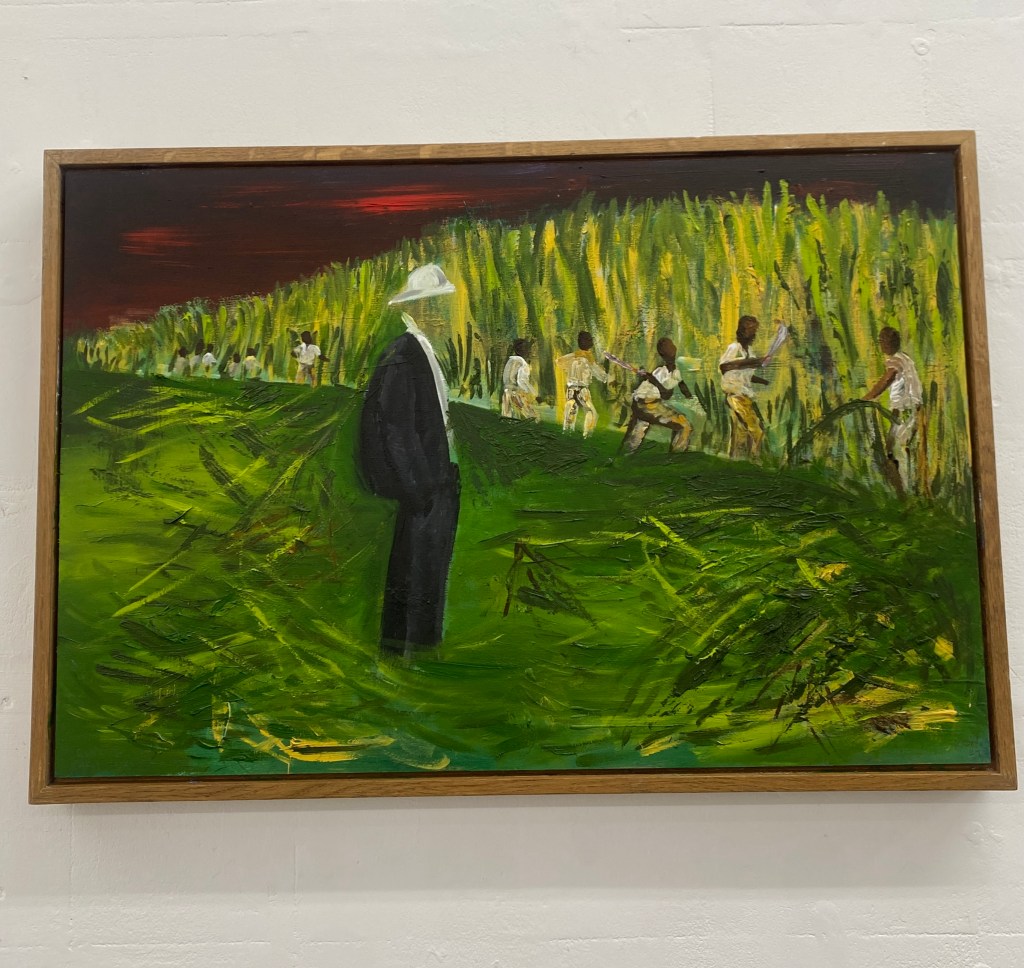
An artwork I reflected on heavily is a painting titled Cutting Cane, Early Morning – 1973. The rough texture of the oil paint to mimic grass and Sugar Cane stalks amongst the softness of the texture within the skyline further emphasized the nature of context within this painting. This artwork challenges one’s way of seeing because I questioned how many viewers of multiple backgrounds responded to this work. Seeing this work as an Afro-Latina woman of Caribbean descent led me to feel triggered.
Wilks’s decision to make the figure within the foreground completely faceless amongst the notable brown faces adds another layer to the narrative regarding the treatment of many black and brown people during that time and how it still has left such a traumatic impact on generations to come while those who have caused these tragedies were granted the ability to hide in the background.
While I was looking at this artwork, I was invited into a conversation with Wilks’s father who goes by Kafu. During this conversation, we both reflected upon this particular artwork and Kafu shared with me how he is a visual artist as well. Throughout Kafu’s heritage and artistic practice, Wilks has been led to discover so much about his Bermudian and Jamaican ancestry while incorporating his collective memory throughout his work.
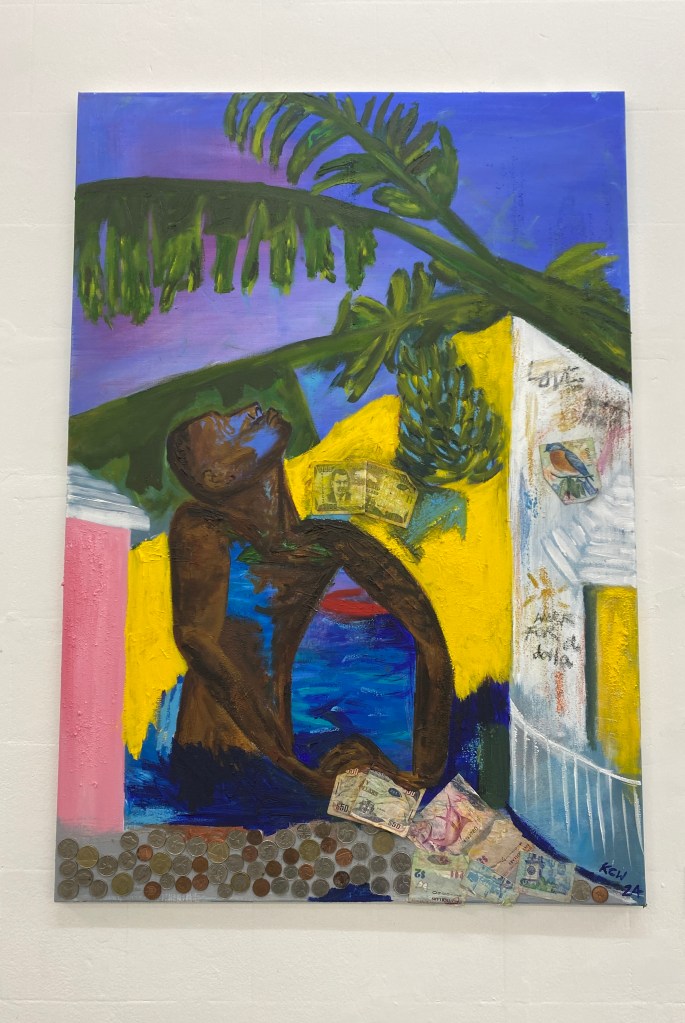
I had the opportunity to speak with Wilks during my visit and he stated that his intention that went into the creative process for most of the artworks on display was the result of a rediscovery of his identity through the use of oil and acrylic. He reinforced that the body of work on display has been and continues to be a tool to connect to the facets of his heritage.
Through this conversation with Wilks, I also learned that he is currently studying law at university. When I asked if he foresees both his creative and law practice intersecting in any way, he responded by letting me know he hopes they do at some point but still is in the process of discovering what path of law he will choose to go down.
It’s not common that I get to speak to the artist, but also be able to speak with their father in several ways that led me to grow fonder of the work. Thus this experience has left me completely enthralled to see how Kennedy Wilks continues to grow within his journey.
Gallery 1957 is pleased to present Constellations Part 1: Figures On Earth and Beyond co-curated by Katherine Finerty, Nuna Adisenu-Doe and Tracy Naa Koshie Thompson.
Exhibition Duration:
14 March – 25 May 2024
Gallery Location:
Gallery 1957,
1 Hyde Park Gate, London
SW7 5XE, United Kingdom
There’s something so special about an exhibition having the aptitude to pique one’s interest and curiosity before entering the space. Gallery 1957 achieves this with its current exhibition Constellations Part 1: Figures On Earth and Beyond. As you approach the towering door that leads into the gallery, stark black faux leaves hang above and around in large piles greet you at the door entrance. Thus, this allows the gallery to stand apart from the neighboring grand Hyde Park Gate homes.
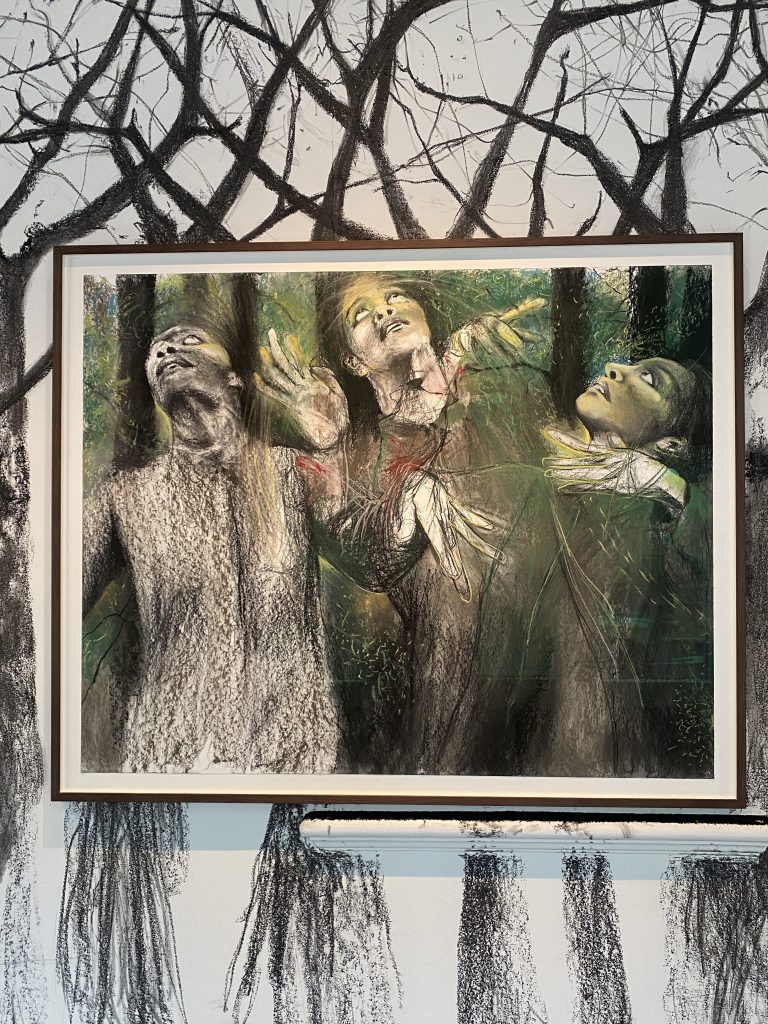
Upon entering the gallery, you start to piece together the narrative with the work of Phoebe Boswell. The installation at the entrance guides the viewer into Boswell’s forestscape through strong black markings of branches and roots. In the artwork titled The Most Penetrating Preachers, we see three figures engaging in what seems to be ceremonial movements in tandem with the movement of the trees. The way Boswell’s charcoal drawings expand beyond the frames onto the wall depicts the symbiotic relationship between humans, spirituality, and the environment.
The way this exhibition groups together so many different materials, disciplines, and narratives that have an incredible way of gravitating the viewer to examine their relationship with the earth and all its elements truly does feel like entering a forest of curiosity.
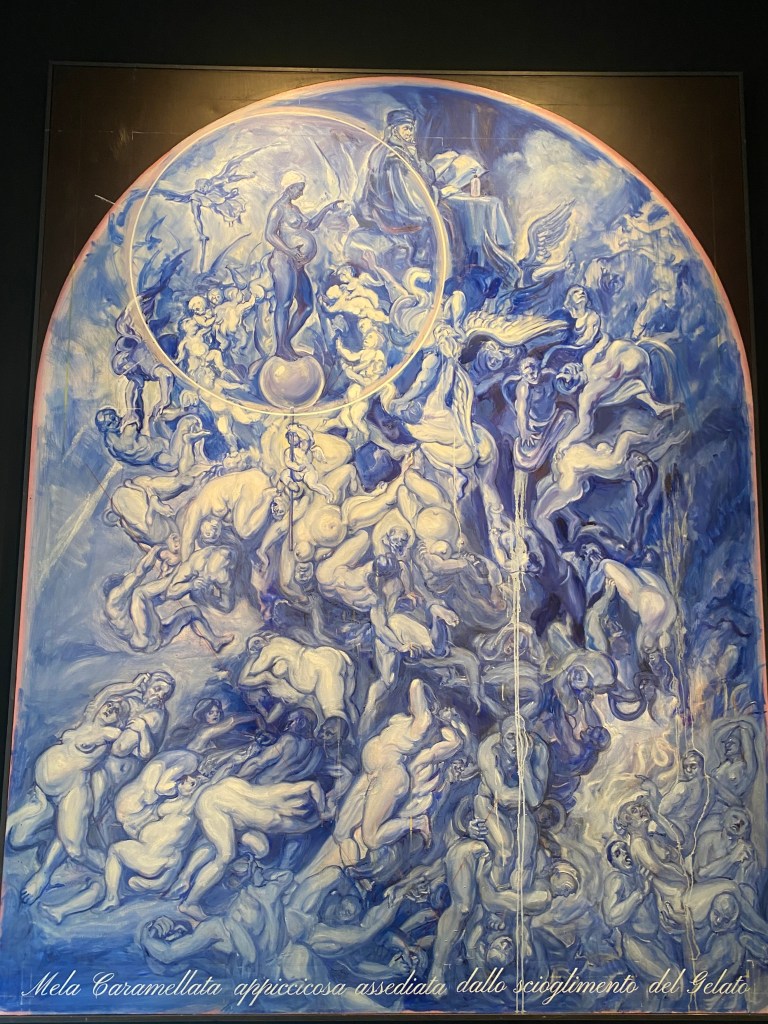
An artwork that completely stopped me in my tracks was a painting titled Original Sin (Inner Circle) by Johannes Phokela. The scale and almost religious-mosaic shape immediately grabbed my attention, alongside the title of this artwork. I began to reflect on the original sin narrative of Adam & Eve. Phokela has fully reimagined this story with a black pregnant woman figure standing on top of the apple raised by cupid angels. The woman figure is enclosed by a circle gradient that works to show the power this figure holds amongst the disciples beneath her. The ‘Original Sin’ story has been replicated and depicted for quite some time, but Phokela’s use of blue hues and impeccable brushwork to depict movement has created this new conversation of reimagining power through the concept of art history and religious motifs.
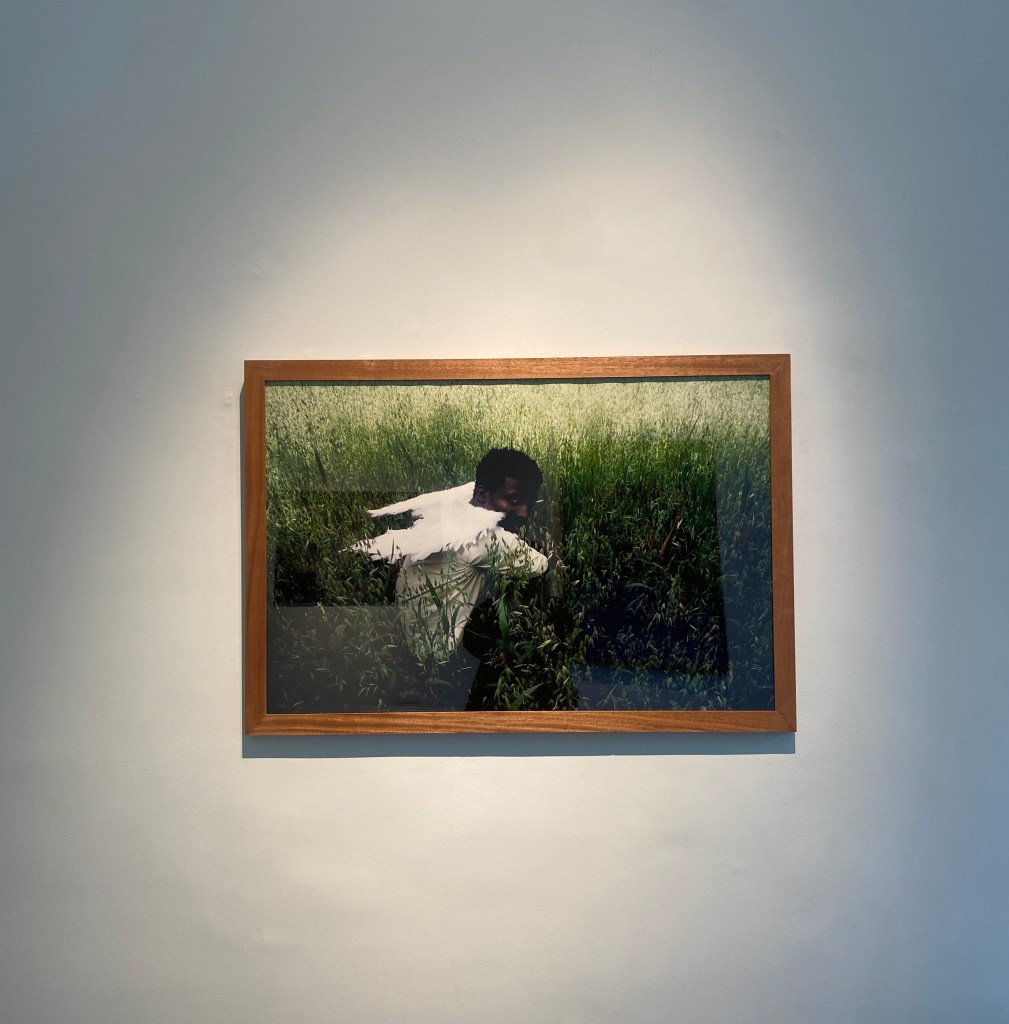
An artwork that flows so well in conversation with the Original Sins by Johannes Phokela is the photograph titled Blue Whispers by Ayomide Tejuoso. Here we see a black male figure adorned with white angel wings and encompassed within the earth as if the figure seemingly fell from the sky. The obscurity of the figure’s face and body adds an unreadable element that is a striking contrast to the Original Sins painting. The adorned angel wings led me to integrate the spiritual, environmental, and human relationships that have been a common thread within this exhibition.
Katherine Finerty, Nuna Adisenu-Doe and Tracy Naa Koshie Thompson successfully bring together a group of artists working within varied disciplines to create many conversations surrounding themes of the human relationship with the earth, art history, science, technology, and so much more. It is also evident through the neighborhood that Gallery 1957 sits in that it is a home turned gallery, and the great duality of the nature of this space sitting across from Hyde Park is another conversation in itself.
This exhibition left me wanting to lay in the grass and allow my mind to roam amongst the earth that sits beyond my spine and decenter myself as part of the larger ecosystem.
The Autograph Gallery is pleased to present Wilfred Ukpong: Niger-Delta / Future-Cosmos
Exhibition Duration:
16 February – 1 June 2024
Gallery Location:
The Autograph Gallery,
First Floor, Rivington Place, London
EC2A 3BA, United Kingdom
This is one of those exhibition that inspire viewers to integrate their imagination with reality. Wilfred Ukpong utilizes the concept of Afrofuturism and mysticism to depict narratives that communicate the environmental crisis today, specifically within the Niger Delta.
Ukpong takes us through an afro-futuristic journey set in his homeland, the Niger Delta to acknowledge and effect a change in the environmental crisis that has been produced by major oil-producing colonies. The Niger Delta was once a major producer of palm oil for Britain and is considered the mainstay of the Nigerian economy for its large oil reserves and its rich biodiversity.
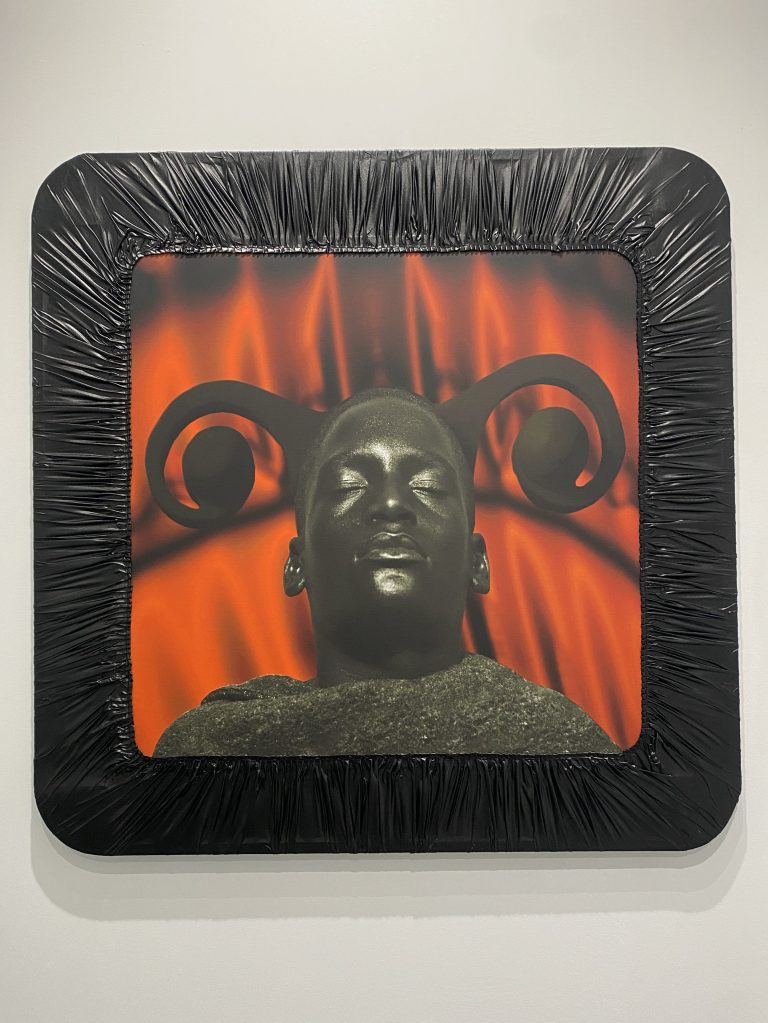
The photograph titled, “Are My Dreams Too Bold For The Carbon Skin I Bear #2? Wrapped in a black material that reads as oil hugging the photograph immediately grabbed my attention. The title opens a window to so many avenues, while accompanied by these stark photographs leading to a surrealist mindscape of potential perceptions. All the while a video documentation plays alongside, the quote, “A question of survival, now is our moment for action.”
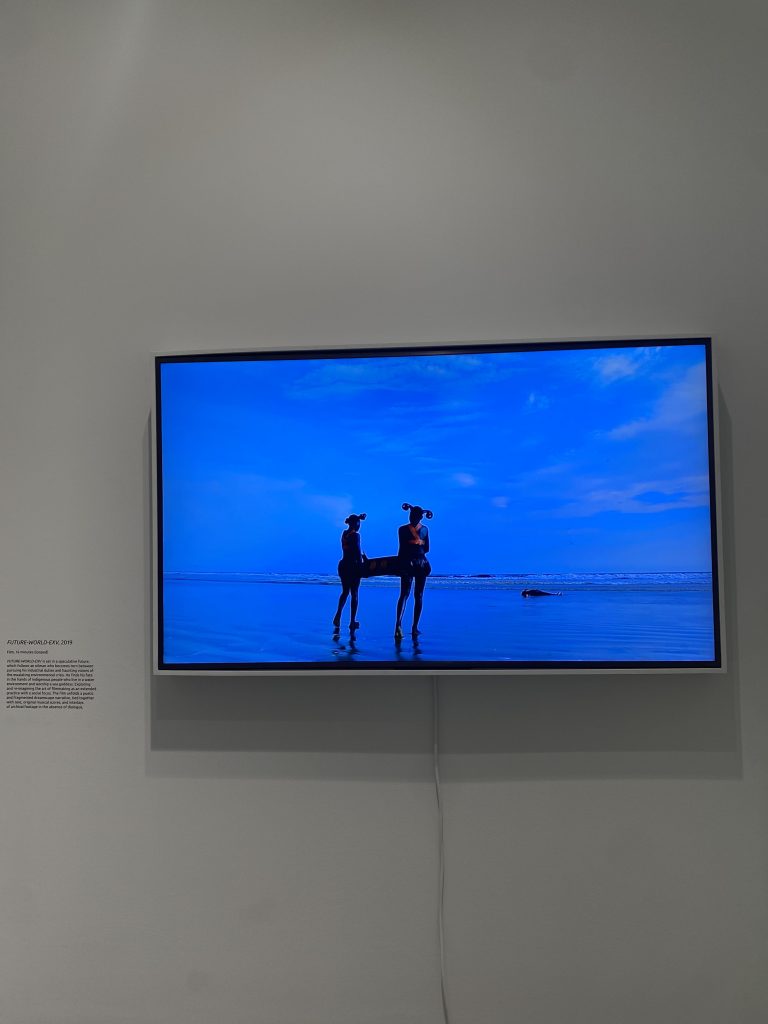
Through photographs and video documentation, we can witness rituals intertwined with performance and ceremonial themes of Ukpong reimagining another world that lives within the ocean beyond the environmental crisis. The way the work transports you into this world with a vast window still letting in the rays of reality serves as a reminder that we are still swimming in this environmental crisis.
This exhibition left me further questioning my relationship with my environment and what is my plan of action.
The Incubator Gallery is pleased to present When The Saints Go Marching, a solo exhibition by Leonard Iheagwam.
Exhibition Duration:
18 – 28 April 2024
Gallery Location:
The Incubator Gallery,
2 Chiltern St, Marylebone
W1U 7PR, United Kingdom
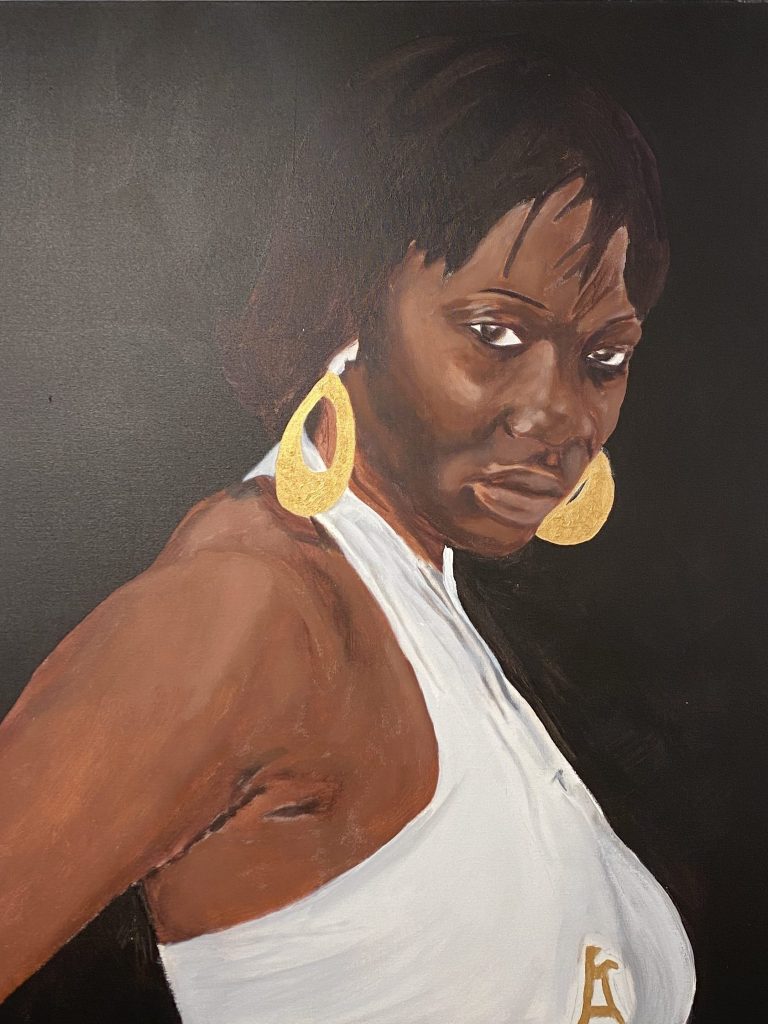
“It’s feel like a celebration of Black culture in here!” This was a statement I overheard as I was looking at this portrait during the opening of When The Saints Go Marching, a solo exhibition by Leonard Iheagwam also known as Soldier at the Incubator Gallery.
There is something so powerful in the gaze of the woman figure in the painting titled, Mercy that doesn’t quite confront the viewer, but the gaze seems to lead to something else in the distance. There is something so lively about the soft yet stark brushstrokes within Soldier’s portraits that carry this serious yet comforting tone to each work.
I initially planned to visit the exhibition during the viewing hours the following week, but attending the opening for this exhibition was quite the treat. To be able to see all walks of life show such great support for Soldier’s first solo exhibition all the while being so present in the space was so warming to witness. The conversations I was able to engage in and overhear all mimicked similar topics surrounding the power of the depiction of blackness, African culture, and the timelessness of visual art.
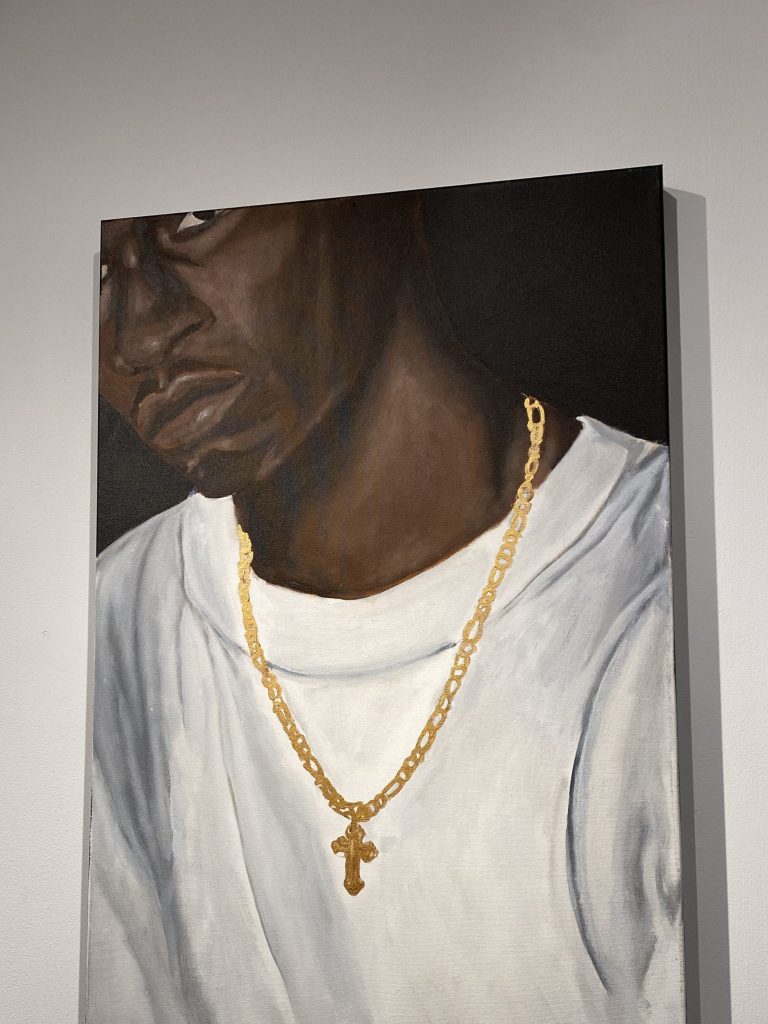
I found myself remarkably captivated by the painting titled, A Proportion. Soldier’s decision to only make a portion of the figure’s face visible where there seems to be more of a focus on the gold rosary chain and the drapery that signals the looseness of the white t-shirt communicates this raw sense of black malehood. These symbols of a crisp white t-shirt and a shining gold rosary chain are so recognizable and give solace to the simple attributes that make black men so special.
Religion, particularly Christian symbolism was a very important element for Soldier to include within his work, in which I later found out that it is a signifier of his experience growing up in an an African Christian household.
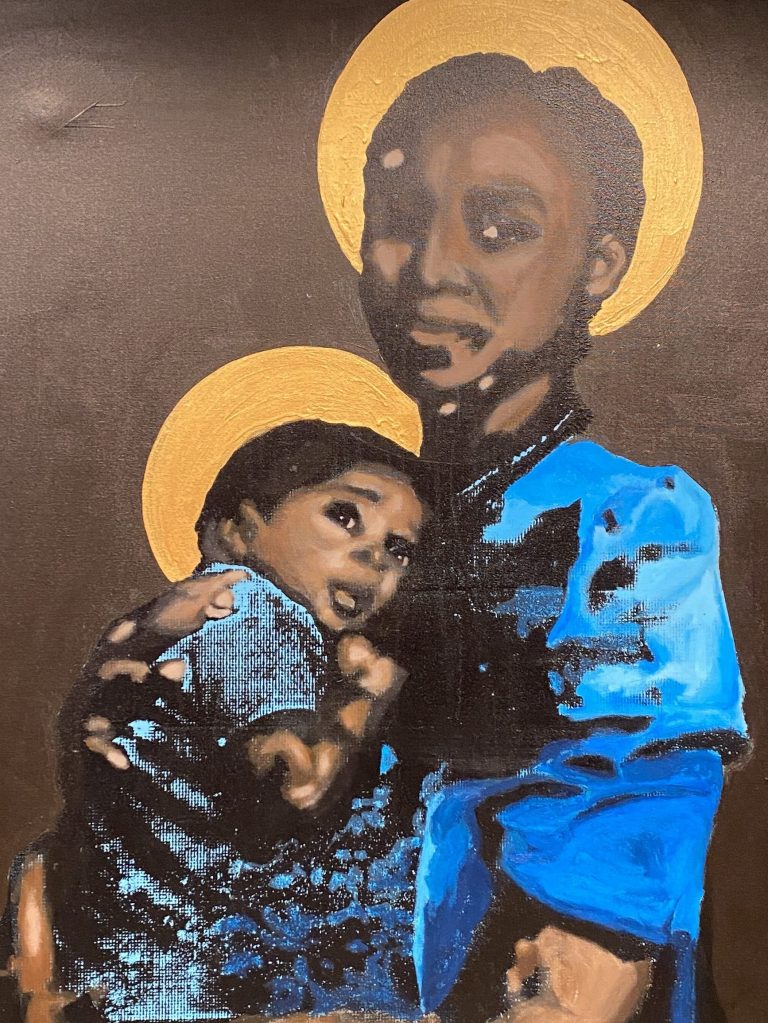
In the painting titled, Remember that I love you dear, we witness a portrait taken from a photo of the artist as a baby with his mother. My immediate thought was the religious symbolism of the halo that surrounds both of the figure’s heads and the poses resembling those of the historical Mother and Child paintings. This painting was neighbored by similar portraits of Soldier’s family members with the identical halo surrounding their crowns. These portraits engage and invite viewers further into Soldier’s lineage and how Christianity has shaped his experience growing up.
This exhibition left me wanting to phone home and further unpack my familial lineage, gain a further appreciation for artists who allow us into their ancestry, and also truly excited to see what is further in store for this artist.
The National Portrait Gallery is pleased to present The Time is Always Now: Artists Reframe the Black Figure, a group exhibition curated Ekow Eshun.
Exhibition Duration:
22 February – 19 May, 2024
Gallery Location:
The National Portrait Gallery, Floor 0
St Martin’s Place, London
WC2H 0HE, United Kingdom
This is one of those exhibitions that leave you wanting to do several rounds to interact with each work fully and wanting to do a deep dive into every artist showcased after you are finished. Ekow Eshun does such a magnificent job of laying out and exploring three themes in Black Contemporary art: Double Consciousness, The Persistence of History, and Our Aliveness.
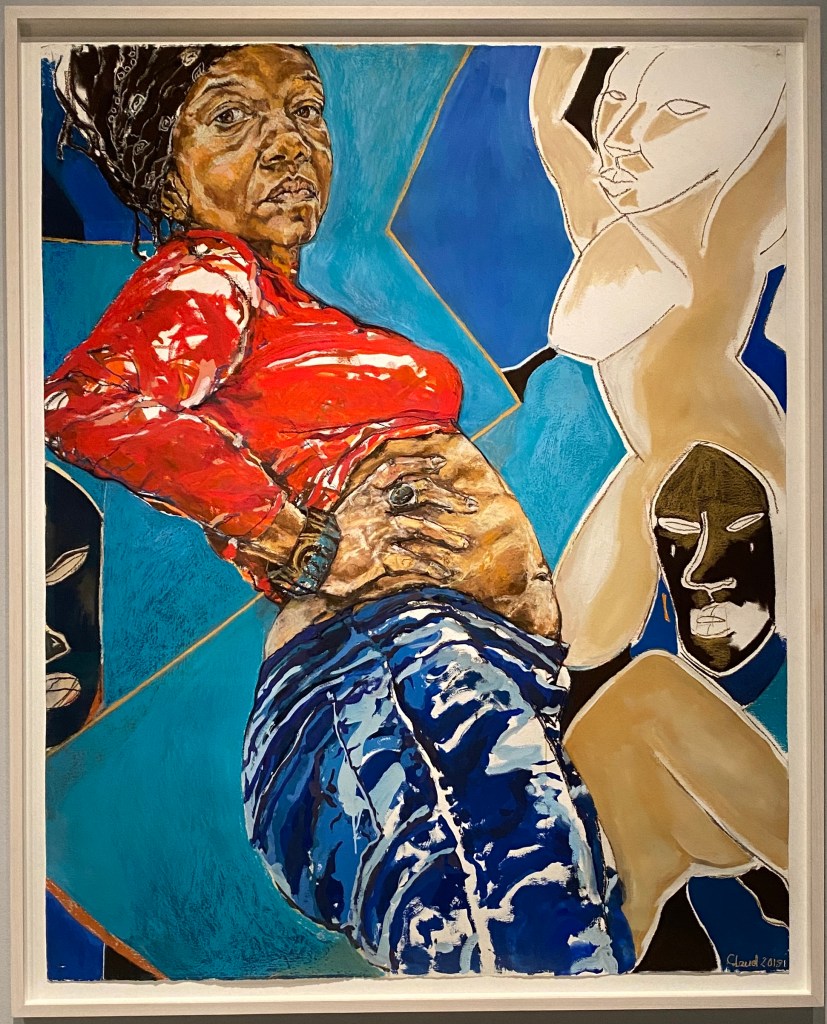
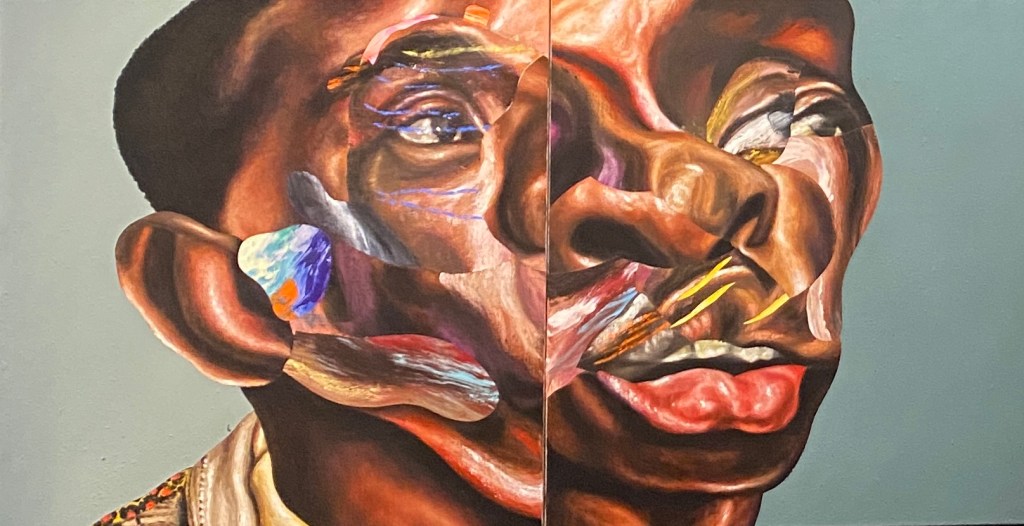
The artwork titled, Standing Figure with African Masks by Claudette Johnson addresses the theme of Double Consciousness by the dystopian nature of the work that led me to question how I look at myself. Is it through the lens of those that see me or is it truly my own? With the main figure’s eyes fully confronting the viewer, hands on hips, and standing tall ready to be faced works great in comparison to Nathaniel Mary Quinn’s paintings that call to question the rendering of black faces in black contemporary art.
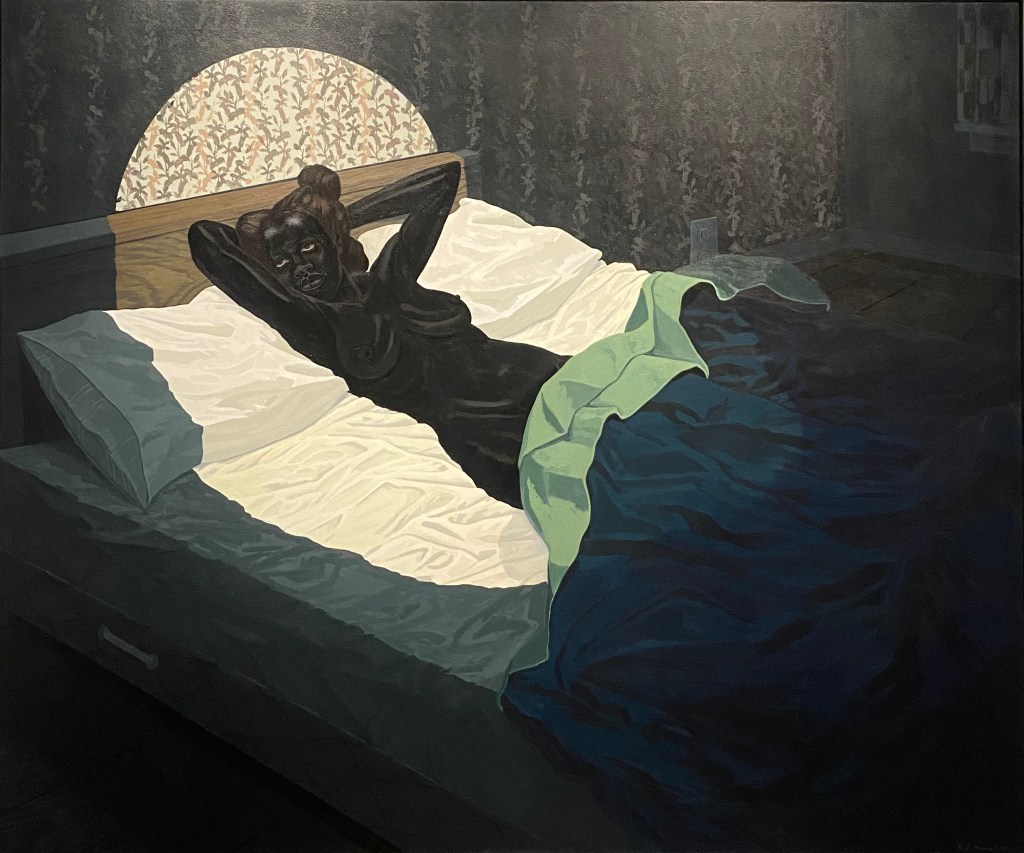
I found myself remarkably captivated by the work of Kerry James Marshall especially the painting titled, Nude (Spotlight). The figure’s position is in conversation with the notable reclining nude posture mostly shown within Western art historical paintings but with the spotlight on a black woman figure. The richness in the figure’s skin tone works so well with Marshall’s message to question and explore the way blackness is depicted. There’s something so serene yet solemn about the expression of the figure in a way that I find myself replicating lately. This brings me to another layer within this exhibition that addresses black viewership. To be a black individual in this space, one can’t help but find themselves in many of these figures. The feelings of emotional resonance, connectivity, and reflections loom in the air as I navigated the different rooms.
Eshun and the supporting curators successfully curated an exhibition space that creates a thread-like path within each theme through different shades of wall colors spanning from deep sea blue brushstrokes in one room to a bold red standing behind silver panels in another room. Thus this amplifies the importance of exhibition design such as wall color when addressing certain messages. For example, the red wall color enhances the power behind Barbara Walker’s work that pushes the envelope of depicting and uncovering the absence of black figures in significant paintings within Western art history.
This exhibition left me thinking and questioning how will we continue to create shifts when addressing themes such as the absence of black figures in Western art history. To be included or to continue to create our own without ignoring or rewriting history?
The PM/AM gallery is pleased to present Exhibition 52, a solo exhibition by Vanessa Garwood.
Exhibition Duration:
27 March – 28 April, 2024
Gallery Location:
PM/AM Ground Floor,
37 Eastcastle Street, London
W1W 8DR, United Kingdom
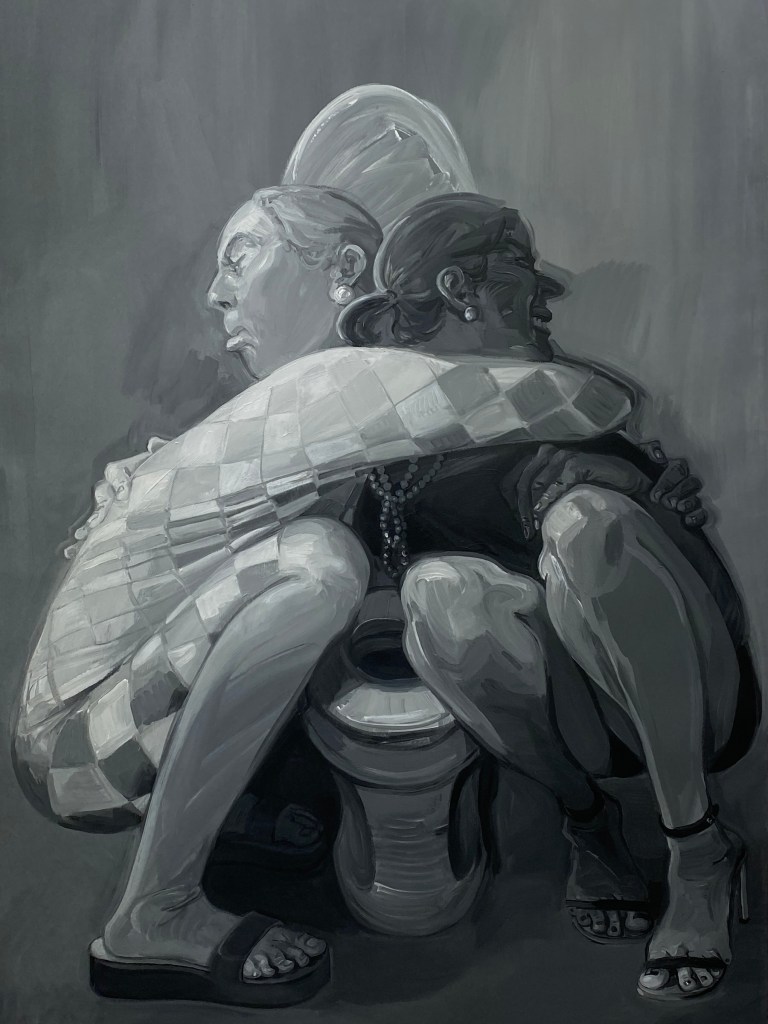
As soon I took a quick overview at the press release email for this show, I knew this was an exhibition I had to see and reflect upon immediately. This solo exhibition highlights the significant shift in Vanessa Garwood’s practice to predominately painting in greyscale as well as the way Garwood showcases the sometimes unseen and special moments during a night out.
When first entering the PM/AM gallery, you are met with nine large-scale black and white portraits that contain scenes that fully drag you in closer. What struck me the most about this show was the stark and yet comforting reflections of womanhood. These scenes include women fixing their makeup in a car on the way out, women emotionally embracing each other over a toilet, and all other activities that happen during a night out on the town.
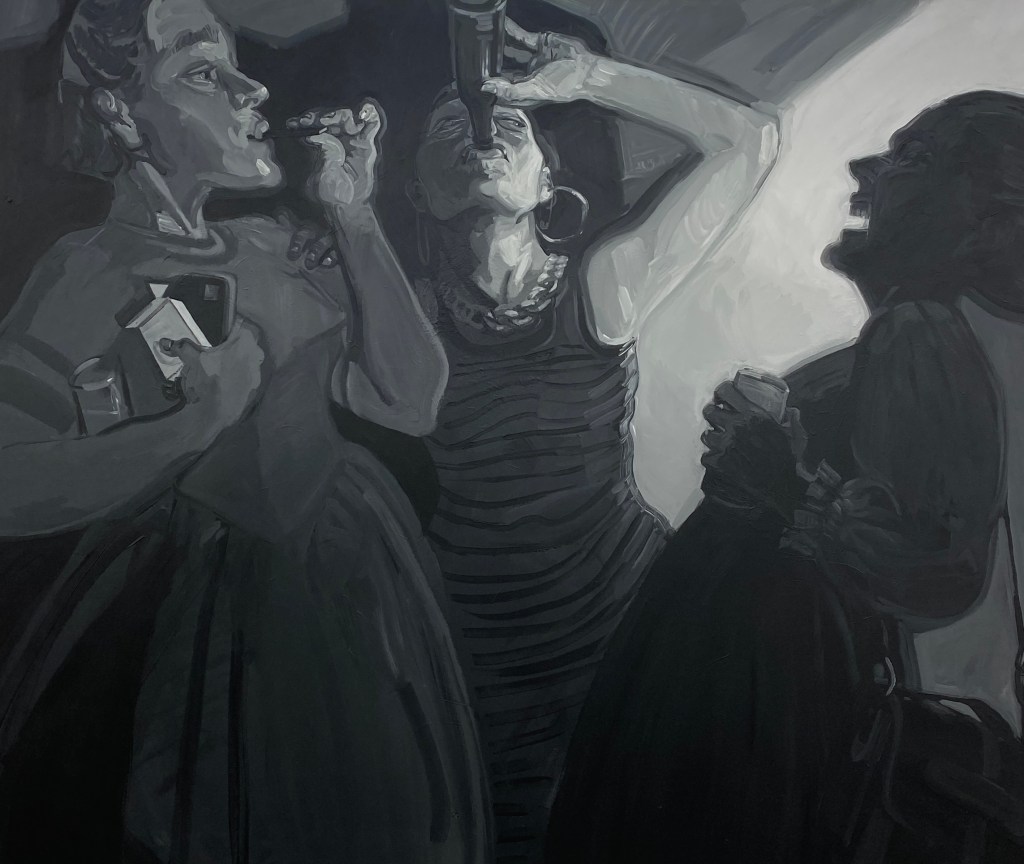
Garwood’s use of scale and lack of color adds such great emphasis on the actions of her figures that are not necessarily critical, but also offer us a glimpse into the internal struggles when celebrating a night out. In the painting titled, “Real Laugh,” we see one woman smoking, another chugging her drink and the third woman throwing her head back in laughter. These actions are somewhat the trifecta of activities that take place during a party. What compels me is the way Garwood’s brushwork places this interesting focus on their necks in a way that highlights the intensity of having to consume substances and alcohol to truly enjoy the night. Adding the layer of the scene withholding color adds this uneasy feeling of pondering what these women may be internally escaping or is this just a means of having a good night?
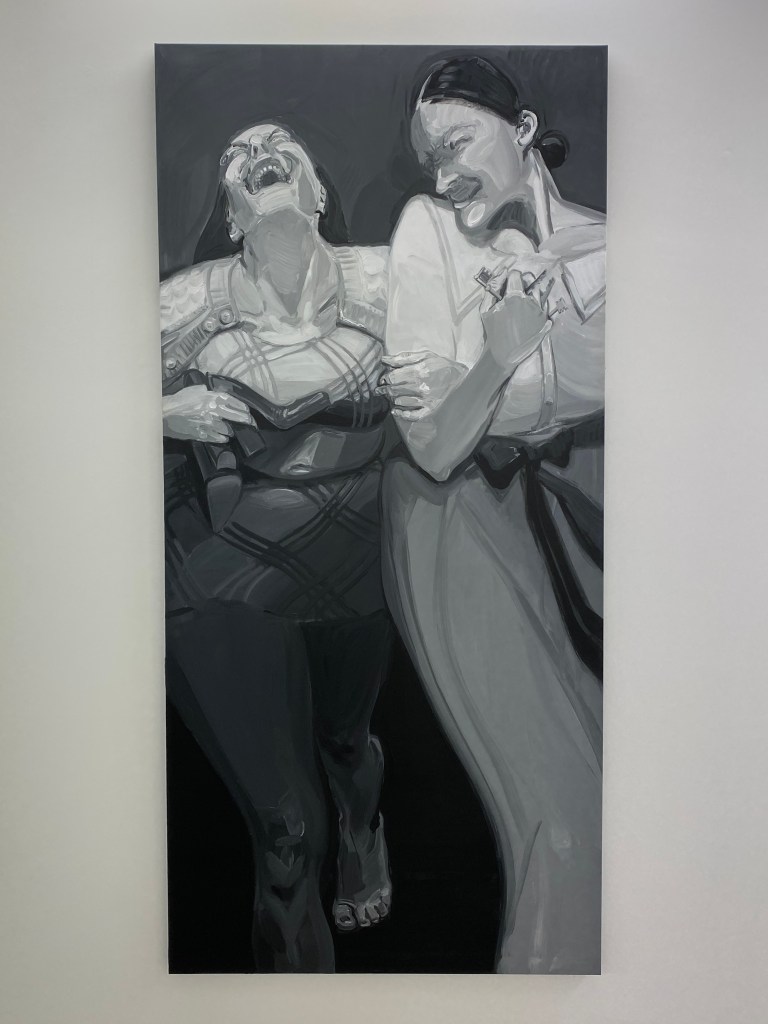
Another painting that I want to touch on in particular as another depiction of displays of womanhood in nightlife is the painting titled, “Key Fist.” There’s something so endearing yet somber about this moment many women have found themselves in. The walk home from the night out where you debrief on all the wild things that happened during the night all the while having to hold safety tools and utilize defensive tactics to protect yourself from those who may want to hurt you during the wee hours of the night. This painting sheds light on what it’s like to be a woman and enjoy nightlife with your girlfriends. It’s the duality of letting loose and having to be on guard all at the same time.
There’s also this overall sense of community that’s not always recognized within nightlife that Garwood successfully encapsulates. This exhibition left me feeling grateful for the community I have to be able to laugh and yet protect one another when going out, but also allowed me a moment to relish in those special moments that have happened during a night out that may have initially caused slight unease now brings me comfort.
The Black Cultural Archives is pleased to present The Ascension Years, a solo exhibition by Tee Max.
Exhibition Duration:
10 August – 3 September, 2023
Gallery Location:
1 Windrush Square, Brixton
SW2 1EF, United Kingdom
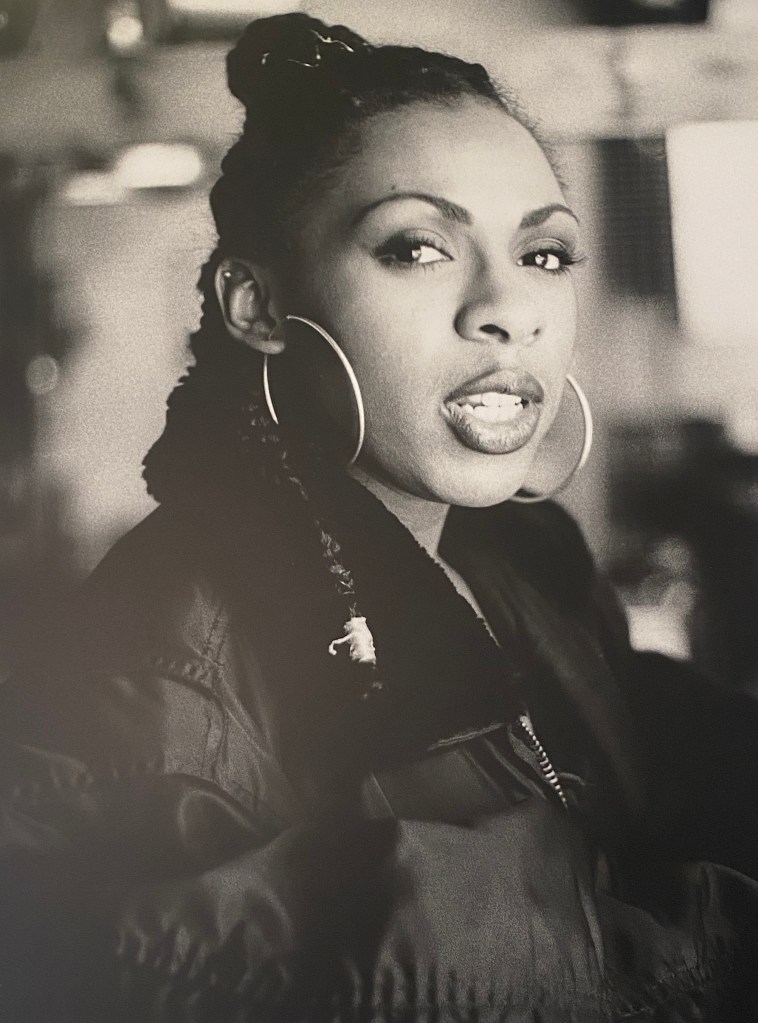
This exhibition highlights the unseen archive of Photo-Documentarian, Tee Max who currently lives & works in London.
With over two decades of experience in capturing some of the most iconic faces in hip hop and R&B, including legends like Biggie, Mary J. Blige and Beyonce. Tee Max’s work has been celebrated for its unique style and ability to capture the essence of his subjects.
Tee Max’s journey as a photographer began over thirty years ago when he first discovered his love for photography. With a natural talent for capturing the Black experience and culture, he quickly established himself, capturing key points of hip-hop history such as Nas’ first-ever trip to the UK and images from the set of the iconic Wu-Tang Clan video ‘Gravel Pit’.
Within this show, viewers are able to be reintroduced to the work of Tee Max and how he’s able to tell authentic stories through each portrait. I am honored to be hosting a talk with Tee Max on 1 September, 2023 at The Black Cultural Archives where will be in conversation regarding the show and his creative practice.
LUNGLEY Gallery is pleased to present Her Vision, a solo exhibition by Dan He.
Oil on canvas, 130 x 120 cm.
Exhibition Duration:
10 August – 16 September, 2023
Gallery Location:
53 Great Portland Street, London
W1W 7LG, United Kingdom
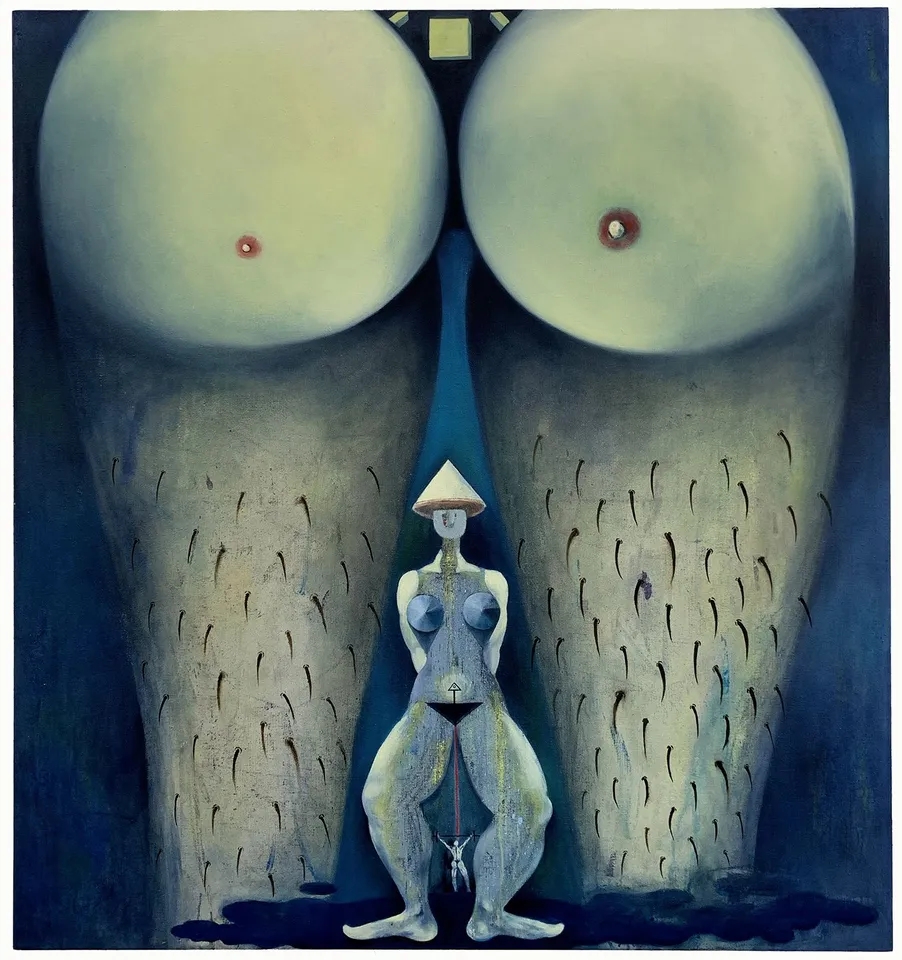
This exhibition highlights the work of Dan He, (Born 1990 in China) currently lives & works in London. She graduated from the Nanchang University, Jiangxi, China with a Bachelor of Fine Art, Majoring in Art Design (2008 – 2012) before continuing her studies at the Repin Academy of Fine Art, St Petersburg, Russia (2014-2015). In 2020 she moved to London and successfully completed a MA in painting at Camberwell college of Arts, London (2021-2022).
Within this show, viewers are able He’s reinterpretation of the traditional theme of the ‘male gaze’ by representing the female form as a dominant and empowering force, in opposition to its historical interpretation as submissive and sexual.
The way that He’s paintings take on an almost surrealistic and futuristic approach, while their formal qualities present intriguing contradictions really intrigued me. The Lungley Gallery took on a feminist approach when it concerns the way in which artwork was carefully aligned within the space and how each label brings you further into how Dan He uses a satirical method to unpack the uncomfortability that comes with the male gaze.
 The Curatorial Forum